Bottom financial quintile student success
Yes, Kalinga Institute of Social Sciences (KISS) Deemed to be University as a body have graduation/completion targets for students who fall into the bottom 20% of household income group (or a more tightly defined target) in the country
Kalinga Institute of Social Sciences Deemed to be University (KISS-DU) is dedicated to ensuring access to quality education and academic success of students from economically disadvantaged indigenous communities.
In order to address the unique challenges faced by its students, KISS-DU places a strong emphasis on supporting them and has set realistic graduation/ completion targets for low-income students, ensuring they successfully complete their programmes and transition into meaningful careers.
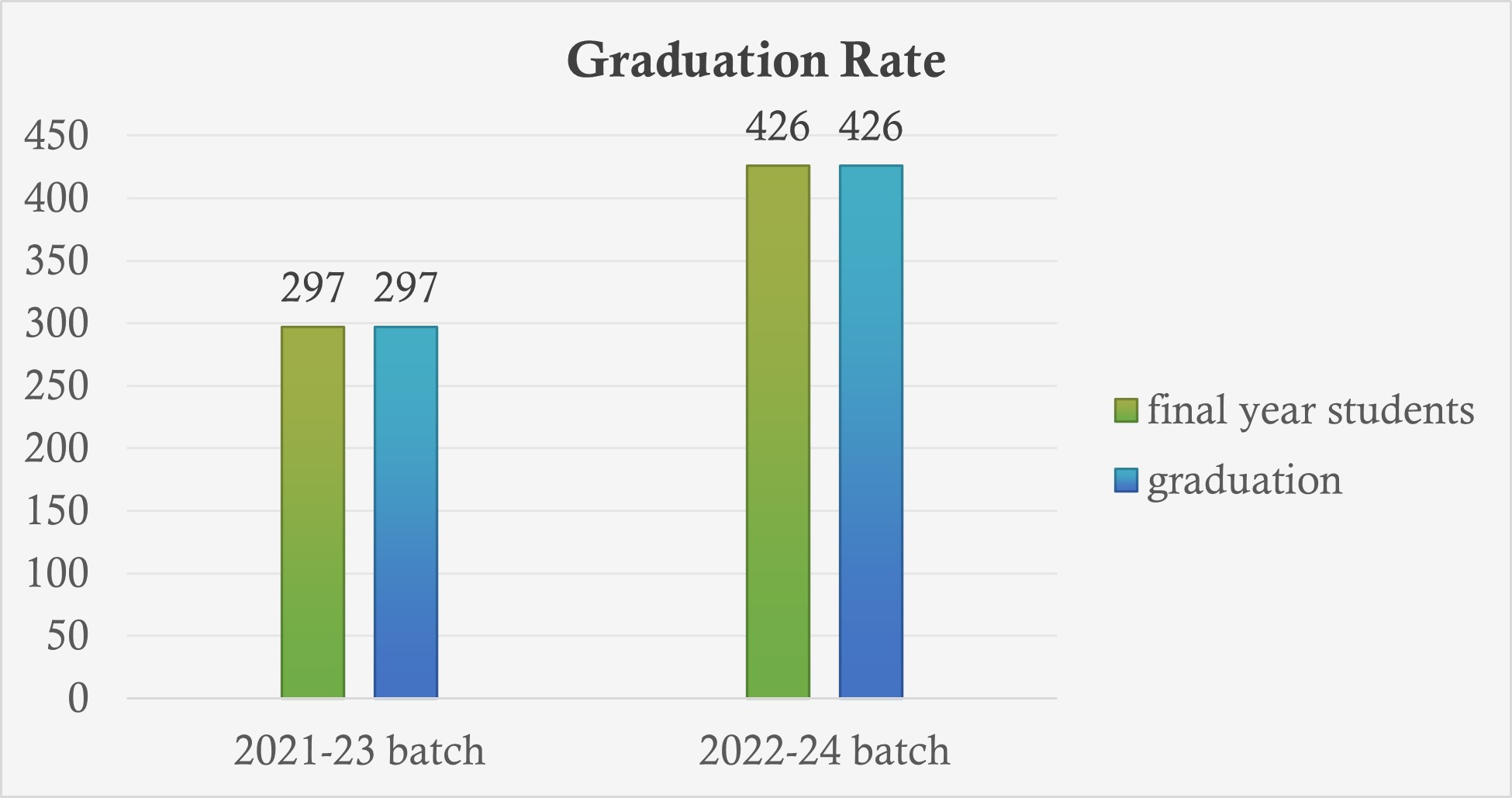
The University has consistently achieved a 0% dropout and 100% graduation rate since inception.
To meet these targets, KISS DU provides extensive academic, personal, and social support tailored to the needs of indigenous students. This support includes mentoring, tutor, career counseling, career preparatory, life skills and vocational education, all of which helps student overcome barriers to academic completion. Additionally, the University offers free tuition, meals, healthcare, and accommodation, alleviating financial burdens and allowing students to focus on their studies.
- Student Centric Teaching & Learning: KISS Deemed to be University focuses on learner-centric education such as participative learning, experiential learning, collaborative learning and self-learning modes. https://university.kiss.ac.in/docs/Criteria-2/2.3.1_teaching_methods/2.3.1_SCAfinal.pdf
- KISS-DU adopts a forward-thinking curriculum designed to empower students through practical and sustainable learning pathways:
- MTB-MLE: Since its inception, KISS has celebrated the diversity of indigenous languages and dialects. It has consistently focused on imparting classroom teaching in the mother tongue at elementary levels before transitioning to a common language. This one of its kind pioneering effort of KISS took a concrete shape in MTB-MLE is a well-established strategy to address language gaps in early learning. The MTB-MLE programme at KISS is sustained within the formal education system of KISS, allowing the organization to fill gaps in the learning process of indigenous students. https://kiss.ac.in/mother-tongue-based-multilingual-education/
- Implementation of NEP: National Education Policy (NEP) 2020 is the first education policy of the 21st century of Government of India, aimed to address the many growing developmental imperatives of the country. This Policy proposed the revision and revamping of all aspects of the education structure, including its regulation and governance, to create a new system that is aligned with the aspirational goals of 21st century education, including SDG4, while building upon India’s traditions and value systems. NEP was implemented in KISS-DU in 2020. The key components of NEP implemented by KISS-DU towards alleviating poverty includes:
- Multiple entry- multiple exit
- Academic Bank of credits primarily to facilitate storing of credits.
- Three-language policy which requires the students to learn three languages, with at least two being native to India, to promote multilingualism and national unity.
- Balanced Curriculum : KISS-DU offers a balanced curriculum across all its programmes, A blend of Academics, Indian Knowledge System, Artificial Intelligence, Knowledge, Skills and Attitude.
- Skill Development Curriculum: Designed with age-appropriate modules, the curriculum progressively builds vocational and life skills essential for employment and entrepreneurship.
- Integration of Sustainable Food Systems: Drawing from the TIGR2ESS-CHIRAG project, components of sustainable agriculture and food security have been embedded in Post Graduate programmes, including Tribal Sciences, Zoology, Botany, the Under Graduate and Post Graduate programmes in Food Science.
- B.Voc Programmmes: KISS-DU offers B.Vocational programmes in key poverty-reducing sectors like Natural Farming, Entrepreneurship Development, and Renewable Energy from 2024. These programmes blend classroom learning with practical skill development, enabling students to become job-ready or self-employed. Natural Farming trains students in sustainable agricultural practices suited to tribal geographies, while Entrepreneurship and Renewable Energy equip them with tools to innovate and build livelihoods. This alignment of education with real-world income-generating opportunities directly contributes to long-term poverty reduction.
- Programmes in collaboration with NEP Saarthi: https://university.kiss.ac.in/posts/online-interaction-and-orientation-session-for-nep-saarthis/
- Career Counselling by Training and Placement Cell https://university.kiss.ac.in/campus-life/tnpcell/
- Value-Added Courses: As of 2024, KISS-DU offers 60 value-added courses that aim to strengthen students’ employability. These courses span areas such as communication skills, digital marketing, rural finance, and project management. Tribal students are thus equipped with competitive skills that improve their job readiness. The courses have been curated to bridge the gap between academic learning and the specific requirements of public, private, and development sector employment, contributing directly to long-term poverty alleviation.
- Mentor Mentee Policy: The University is focused and committed to enable learners to access student support mechanisms to meet their academic and psycho-social needs. The Mentor- Mentee Policy is inclusive and applies to all faculty members and all students. The Policy ensures that the mentees can share and discuss academic, social, and personal issues with their mentors, hence collectively working towards their holistic development. Thus, a personal relationship is created for better understanding of the mentee’s aspiration, strengths and weaknesses. The University is committed to regularly review the effectiveness, applicability of the Mentor-Mentee Policy and procedures and make amendments wherever necessary based on the evolving needs of the mentees involved. Policy available: https://university.kiss.ac.in/3d-flip-book/mentor-mentee-policy/
- Peer Group Learning Support and Remedial/ Additional Learning Support (RALS) Policy: https://university.kiss.ac.in/3d-flip-book/special-academic-support-policy-for-students/
- Peer Group Learning Support is a collaborative learning method where students work in small groups to understand course content, solve problems, and enhance their academic skills through peer-to-peer interactions, group discussions, study sessions, and collective problem-solving activities.
- Remedial/ Additional Learning Support (RALS): Remedial/Additional Learning Support (RALS) is a program that helps students overcome academic challenges by providing targeted instruction, including remedial classes, tutorials, and personalized coaching sessions, aiming to improve students’ knowledge and skills, boost their confidence, and enhance their academic progress.
- Bridge Courses/ classes: Bridge courses are preparatory courses designed to help students transition smoothly into higher education by covering essential concepts not adequately addressed in their prior academic experiences. They are beneficial for students entering new fields, changing academic tracks, or needing reinforcement in prerequisite subjects, preparing them for successful engagement with advanced coursework.
- Slow Learners: Slow Learners are students who may take longer to grasp academic concepts compared to their peers due to various factors such as learning difficulties, language barriers, or a lack of foundational knowledge. Slow learners receive personalized support, including tailored learning plans, remedial sessions, and continuous mentoring, to help them achieve academic success at their own pace.
- Advanced Learners: Advanced learners are students who excel in academic tasks, demonstrate strong analytical and critical thinking skills, and are capable of independent learning. They are provided with enrichment opportunities like advanced courses, research projects, leadership roles, and participation in competitions and seminars to nurture their talents.
- Successful alumni from the same family and community looked up as Role Model by students.
- KISS Competitive Preparation Centre (CPC): In order to ensure placement and employment to all students post-graduation,coaching classes are organized by the CPC for all UG and PG students at the Higher Education Campus. At these classes, special emphasis is placed on preparing students for competitive examinations, conducted by recruitment boards in varied fields, including but not limited to Banking, Railways, and Police Service. We also prepare students for examinations by the Staff Selection Commission, Subordinate Selection Commission, Odisha Public Service Commission (OPSC), Union Public service Commissions (UPSC) etc.
- Counselling by KISS Wellness Centre : The KISS Wellness Centre provides counseling to help students with emotional, social, and academic issues, aiming to promote holistic development and happiness. There are two Counselling Centers located in the campus 3 and 4, one for the girls and the other one for the boys. Centers are functioning in their respective hostels for easy accessibility of the boys and girls students. Rooms are spacious, well-ventilated, comfortable sitting arrangement with a soothing ambience and total privacy. https://university.kiss.ac.in/campus-life/wellness/
- Professor Robin Edward Gearing from the University of Houston delivered a distinguished invited lecture on “Informing suicide Prevention Pathways: Targeting ideation and Behaviour” on 7th November 2024. This lecture was organized by the Internal Quality Assurance Cell and School of Tribal Culture, Philosophy and Eco-spiritualism, in collaboration with Centre for Indigenous Cultural Heritage and Diversity and KISS Wellness Centre. https://university.kiss.ac.in/posts/international-distinguished-invited-lecture-on-suicide-prevention-and-special-session-on-writing-projects-and-grants-applications-held-at-kiss-du/
- The Psychology Program of the School of Tribal Heritage and Tribal Indology (STHTI) at KISS Deemed to be University (KISS-DU), in collaboration with the KISS Wellness Centre, organized an awareness seminar on the occasion of World Suicide Prevention Day on 10th September 2024. The event, based on the theme “Suicide and Its Prevention”, aimed at raising awareness among students, faculty, and staff about mental health issues and promoting strategies for suicide prevention. https://university.kiss.ac.in/posts/university-level-seminar-marks-world-suicide-prevention-day-at-kiss-du/
KISS-U’s holistic support framework has led to notable success in the graduation rates of students, empowering them to complete their education and embark on professional journey. By doing this, KISS-DU helps create a new generation of educated, enabled and empowered individuals who can positively impact their indigenous communities. This commitment contributes to the university’s broader mission of social transformation and eradicating poverty (SDG-1). The interventions have helped to maintain 100% graduation rate among the students, since inception.
In academic session 2024, 426 PG students passed out with 242 girl students.