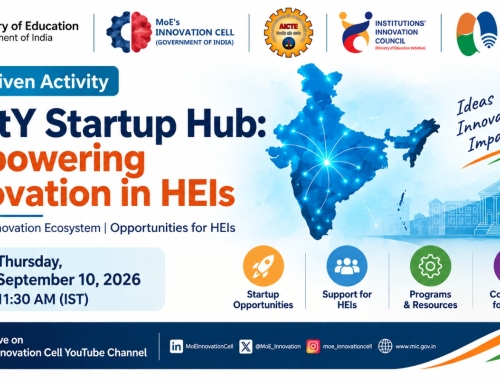
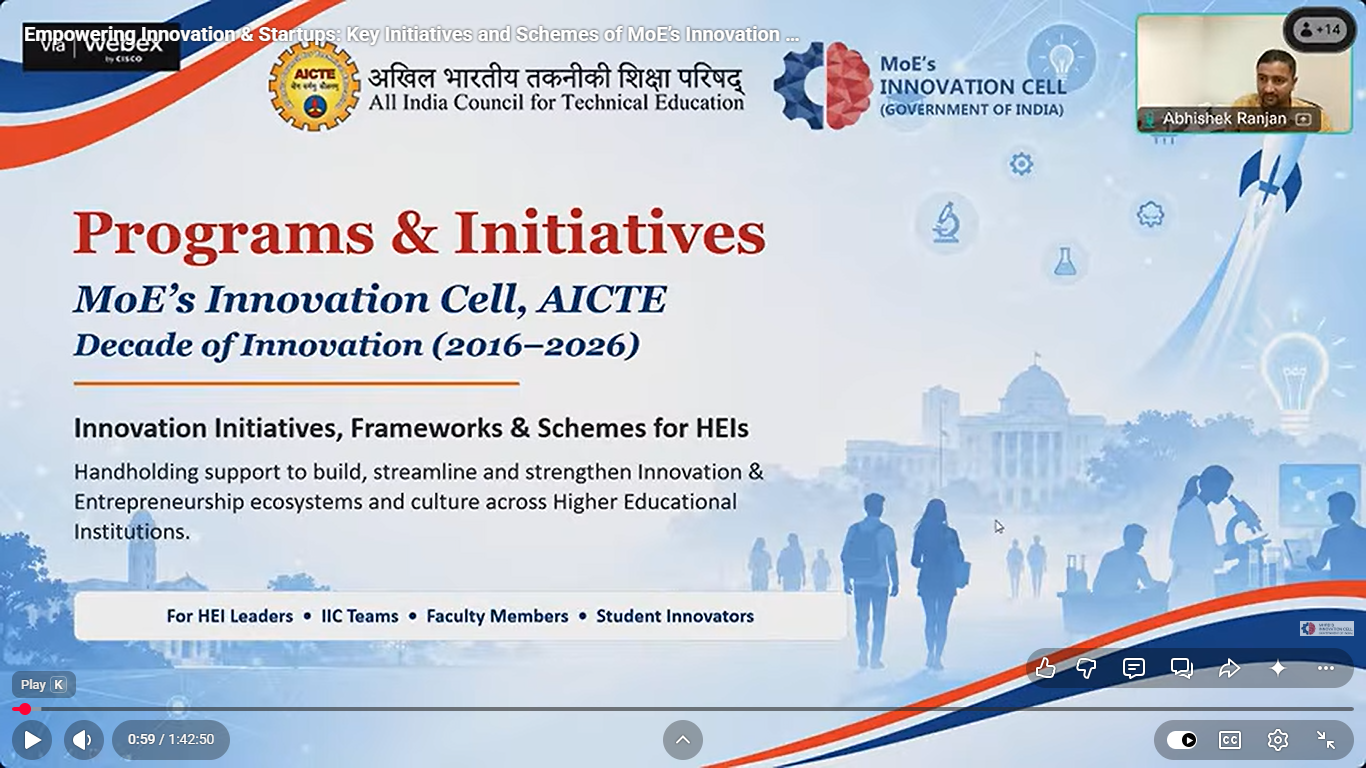
The Institution’s Innovation Council (IIC) of Kalinga Institute of Social Sciences (KISS) Deemed to be University (KISS-DU) on 25th August 2026 organized a Ministry of Education’s Innovation Cell (MIC)-driven activity by facilitating the viewing of the online session titled “Initiatives & Programmes to Support Innovation in Higher Educational Institutions (HEIs) | Atal Innovation Mission, NITI Aayog.” The programme brought together members of the KISS-DU Innovation ecosystem to understand national initiatives that can help higher educational institutions strengthen innovation, entrepreneurship, incubation and startup development.
Addressing the session, Mr. Pramit Das and Ms. Deepali Upadhyay from Atal Innovation Mission (AIM), NITI Aayog, explained how AIM supports innovators across the life cycle—from nurturing scientific temper among school students to enabling early-stage enterprises and market-ready startups. They highlighted the role of strategic infrastructure, mentorship, institutional partnerships and funding in translating ideas into scalable solutions.
Key Highlights of the Session
- Atal Tinkering Labs (ATLs): School-based maker spaces that expose learners to tools such as electronics, robotics, sensors, microcontrollers and 3D printing, while developing design thinking, creativity and scientific temper.
- Atal Incubation Centres (AICs): Sector-focused incubation facilities that provide startups with co-working space, technical and business mentorship, prototyping support, investor access and opportunities for commercialization.
- Atal Community Innovation Centres (ACICs): Community-oriented incubation initiatives designed to reduce regional disparities and promote grassroots innovation and micro-entrepreneurship in Tier-3 and Tier-4 locations.
- Human Capital Development: Capacity-building programmes for incubation professionals to strengthen governance, mentoring practices and the long-term sustainability of incubation centres.
- Atal New India Challenge: Grant-based support for technology-led solutions addressing challenges of national importance and societal relevance, with pathways for piloting and market access.
- Industrial Accelerator Programme: An emerging industry-led model intended to connect mature startups with industrial problem statements, co-development opportunities, pilots, supply chains and investment.
- Inclusive and Regional Innovation: Initiatives such as the Frontier and Vernacular Innovation programmes seek to extend ecosystem support to underserved regions and reduce language barriers to innovation.
The activity was particularly relevant to faculty members, researchers, students, innovators, entrepreneurs, startup teams, IIC members, R&D Cell and Incubation Centre of the University. It reinforced the importance of building a connected innovation pipeline that begins with ideation and mentoring, progresses through pre-incubation and incubation, and culminates in funding, market access and measurable social or economic impact.
Participants gained a clearer understanding of how HEIs can engage with AIM initiatives, mentor nearby Atal Tinkering Labs, develop sector-specific incubation capacities, collaborate with industry, support grassroots innovators, and prepare eligible innovators and startups for future funding opportunities. The discussion also underscored the need to assess innovation outcomes through employment generation, intellectual property creation, revenue growth, scalability and the extent to which a solution addresses a real societal need.
The MIC-driven activity strengthened awareness of the national innovation support ecosystem and encouraged the KISS-DU community to pursue greater collaboration, mentorship and institutional participation. Through the programme, KISS-DU IIC reaffirmed its commitment to fostering an inclusive culture in which curiosity is nurtured, ideas are transformed into prototypes, and innovations are guided towards sustainable entrepreneurial and community impact.