Have measurement or tracking of women’s likelihood of graduating compared to men’s, and schemes in place to close any gap.
KISS-DU actively tracks women’s graduation rates to monitor their academic progress and ensure that female students have equal opportunities to succeed. The institution collects and analyses data on the likelihood of women graduating compared to their male counterparts, identifying any disparities or gaps in academic performance and outcomes.
- The University has an Annual Gender Sensitization Action Plan https://university.kiss.ac.in/docs/Criteria-7/7.1.1_Gender_equity/AGSP.pdf
- Gender Audit is conducted annually which included the following:
- Regular monitoring of enrollment, retention, and graduation rates, dis-aggregated by gender, to identify disparities.
- Analysis of academic performance trends across the University to understand challenges faced by women.
- Use of academic and socio-economic data to assess factors influencing women’s graduation likelihood, such as dropout rates and performance gaps.
- Surveys and focus group discussions to gather insights from women students about barriers to their academic success.
- The Examination Cell, KISS-DU maintains semester-wise records of enrolment, progression, retention, and graduation for all students, regularly tracks women students’ academic performance through assessments and gender-disaggregated data. Findings are then shared with the Centre for Women’s Studies to identify trends, address gaps, and provide timely support, ensuring women’s consistent progress, retention, and overall academic success at KISS-DU.
- Centre for Women Studies, KISS-DU conducts systematic gender-based data collection and analysis in collaboration with the Internal Complaints Committee (ICC) and the Internal Quality Assurance Cell (IQAC). This process evaluates women’s participation, academic success, and representation across all programmes and administrative structures, enabling the University to identify gaps, monitor progress, and strengthen the effectiveness of gender-related policies.
- Mentor- Mentee System: University is focused and committed to enable learners to access student support mechanisms to meet their academic and psycho-social needs. The Mentor- Mentee Policy is inclusive and applies to all faculty members and all students. The Policy ensures that the mentees can share and discuss academic, social, and personal issues with their mentors, hence collectively working towards their holistic development. Female students are mentored by female staff members.
Policy available: https://university.kiss.ac.in/3d-flip-book/mentor-mentee-policy/
If any gaps are identified, KISS-DU implements targeted schemes and support programs to close the gender gap and ensure that female students have the resources and support they need to complete their degrees.
These initiatives include:
- Academic support programs: Additional tutoring, study groups, or workshops tailored to the specific needs of female students, particularly those in underrepresented or challenging fields such as STEM (Science, Technology, Engineering, and Mathematics).
- Mentoring and counselling: Female students are paired with mentors or counsellors who offer academic guidance, career advice, and emotional support, helping them navigate challenges both inside and outside the classroom.
- Scholarships and financial aid: Financial support programs, such as scholarships for women in need, help reduce financial barriers that may hinder academic success and retention.
- Flexible learning options: For women balancing family responsibilities, KISS provides flexible scheduling, online learning options, or extended deadlines to help them manage their studies alongside personal commitments.
- Workshops and Training programmes :
- Mahindra Pride Classrooms: Mahindra Pride Classroom is a flagship Corporate Social Responsibility (CSR) Livelihood programme of the Mahindra and Mahindra group and is fully implemented by NAANDI Foundation. The in-person training programme will impart the following skills to the female students of KISS- Life Skills – compassion, respect, gratitude, being a responsible global citizen; Soft Skills – grooming, body language, teamwork, time management, social manners, etc; Communication Skills – functional English & the ability to express clearly in the local language; Presentation Skills – speaking clearly, coherently and confidently; Interview Skills – resume preparation, interview questions, mock interviews and Python Programming.
- Anti Harassment Policy and Gender policy in place https://university.kiss.ac.in/docs/Guidelines/Gender-Policy-2.pdf
By closely tracking graduation rates and addressing the factors that contribute to any gender disparity, KISS is committed to fostering an inclusive academic environment where women have equal opportunities to succeed and graduate. These measures not only help close the gap but also empower female students to pursue their educational and career goals without hindrance.
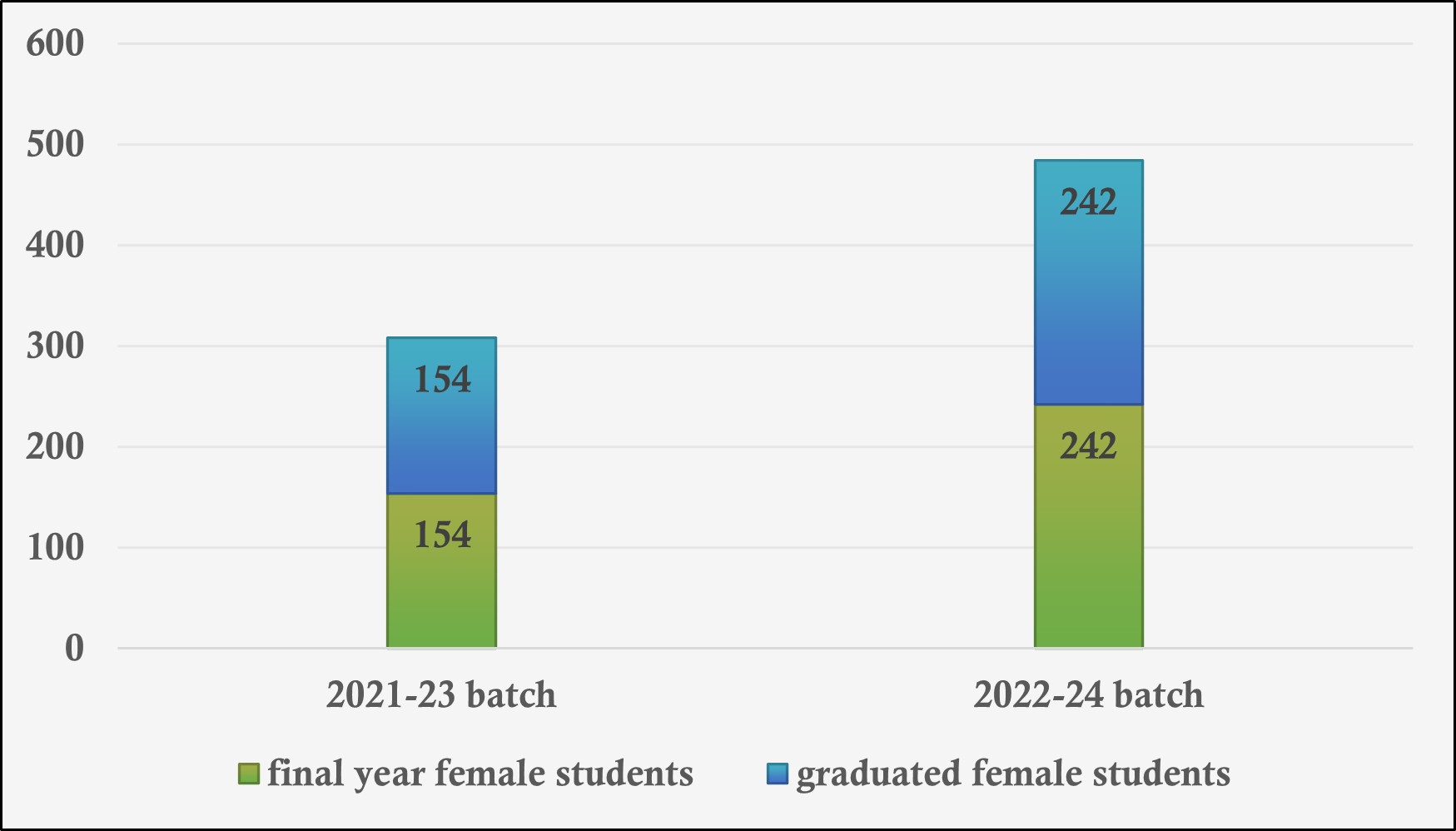
The interventions have helped to maintain a 100% graduation rate among the students, since inception.
In academic session 2024, 426 PG students passed out with 242 girl students.
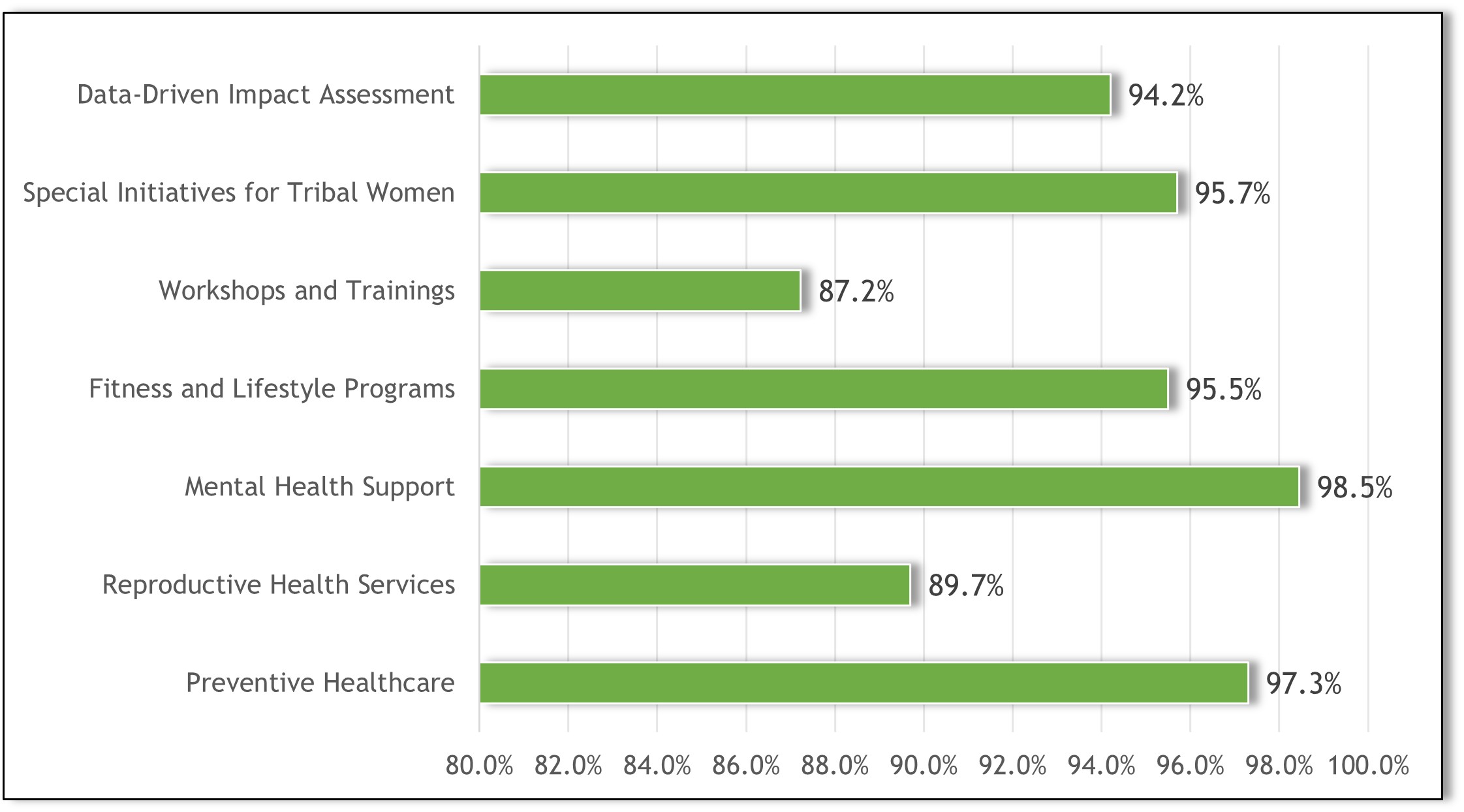
Below is a graphical representation of KISS-DU’s women-centric health and safety programs, highlighting coverage and effectiveness across key areas: