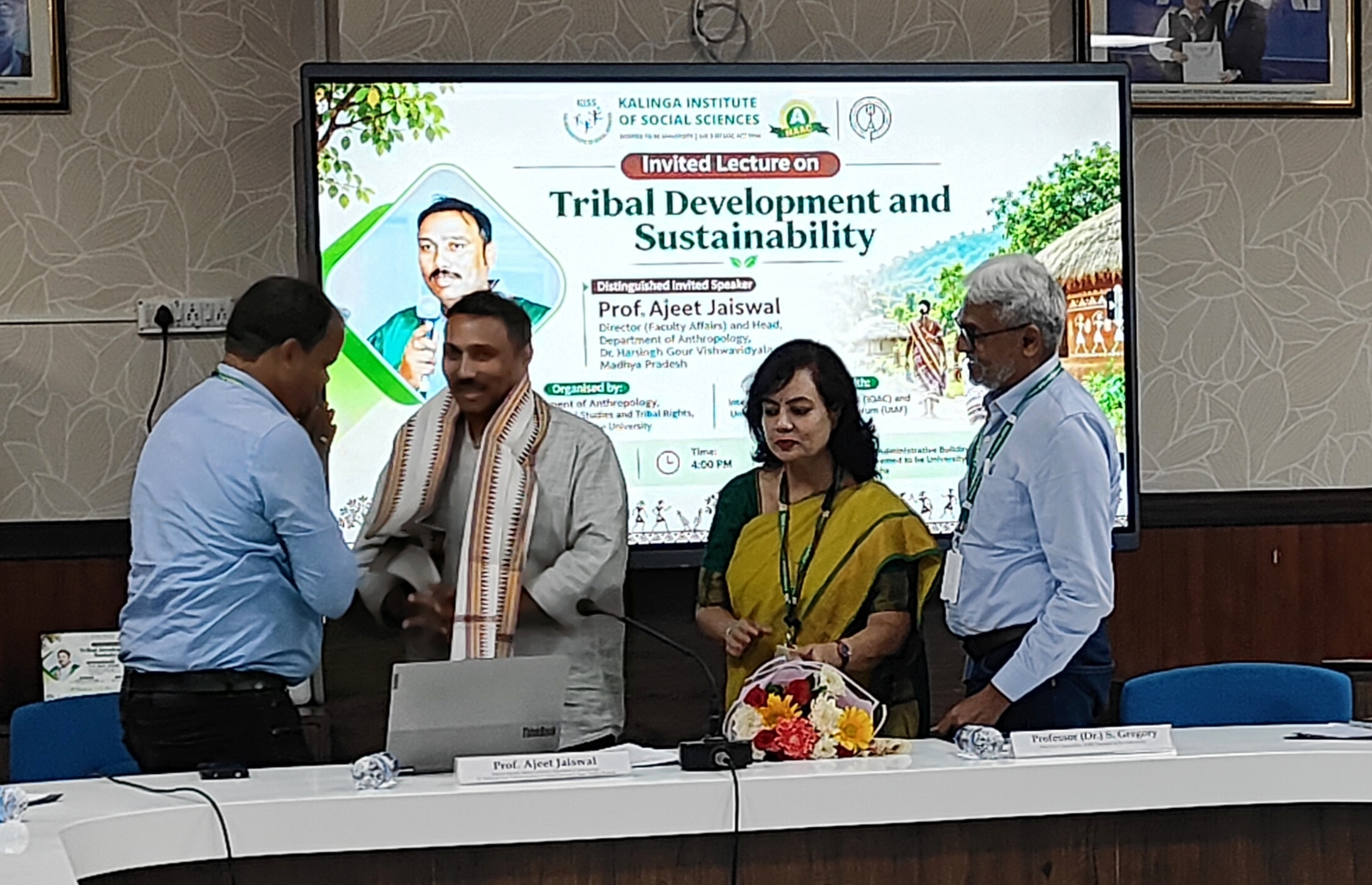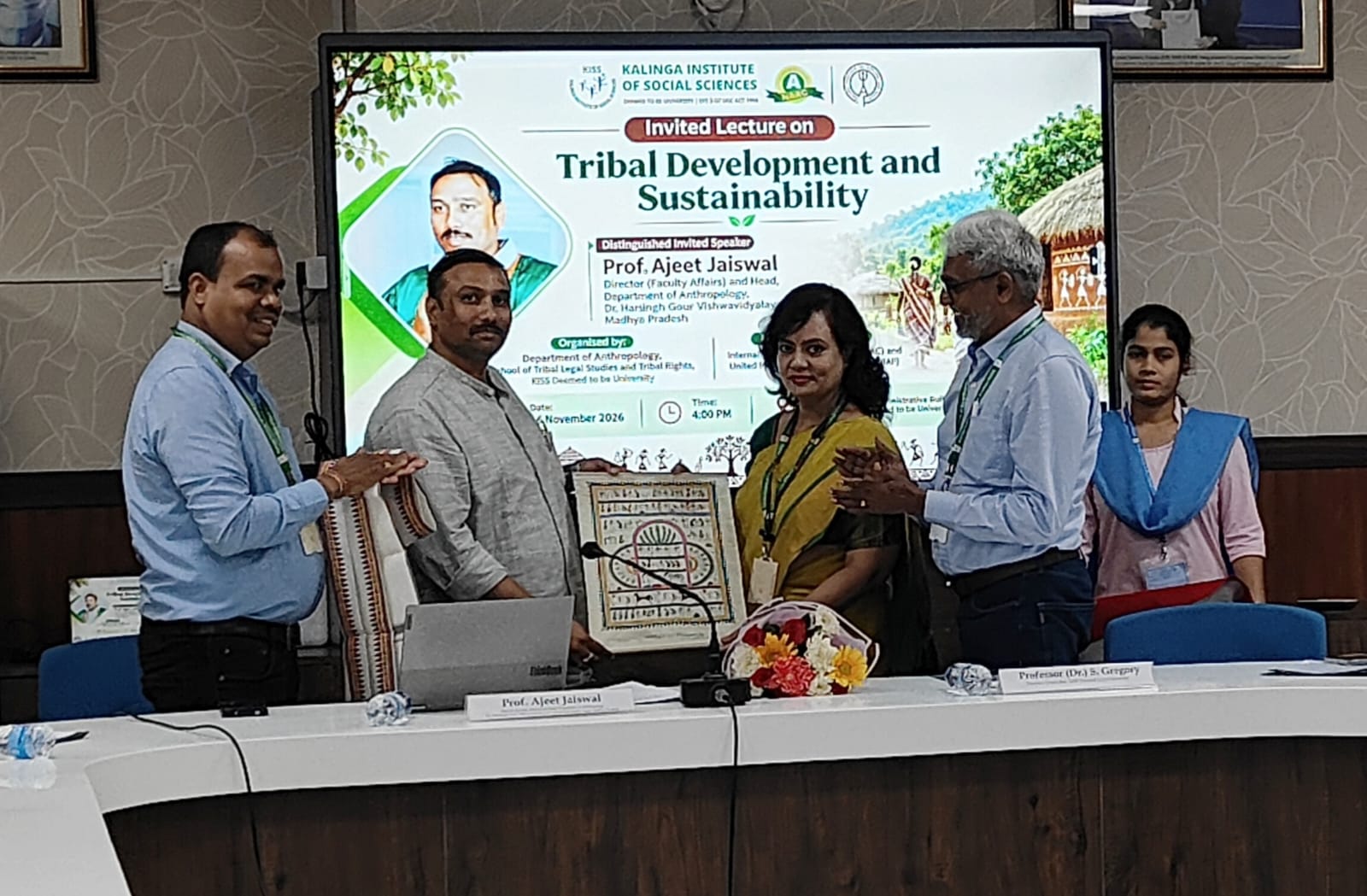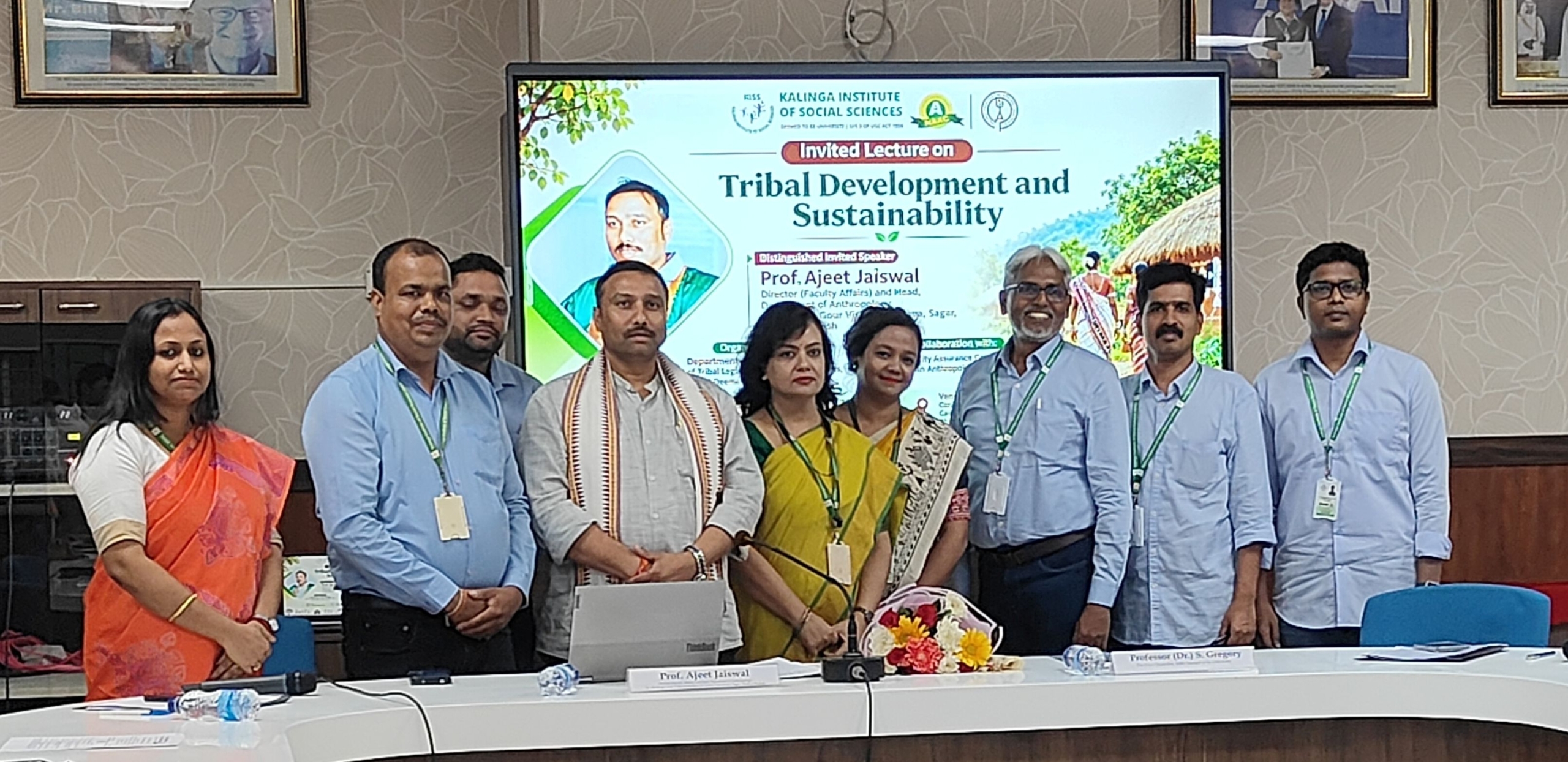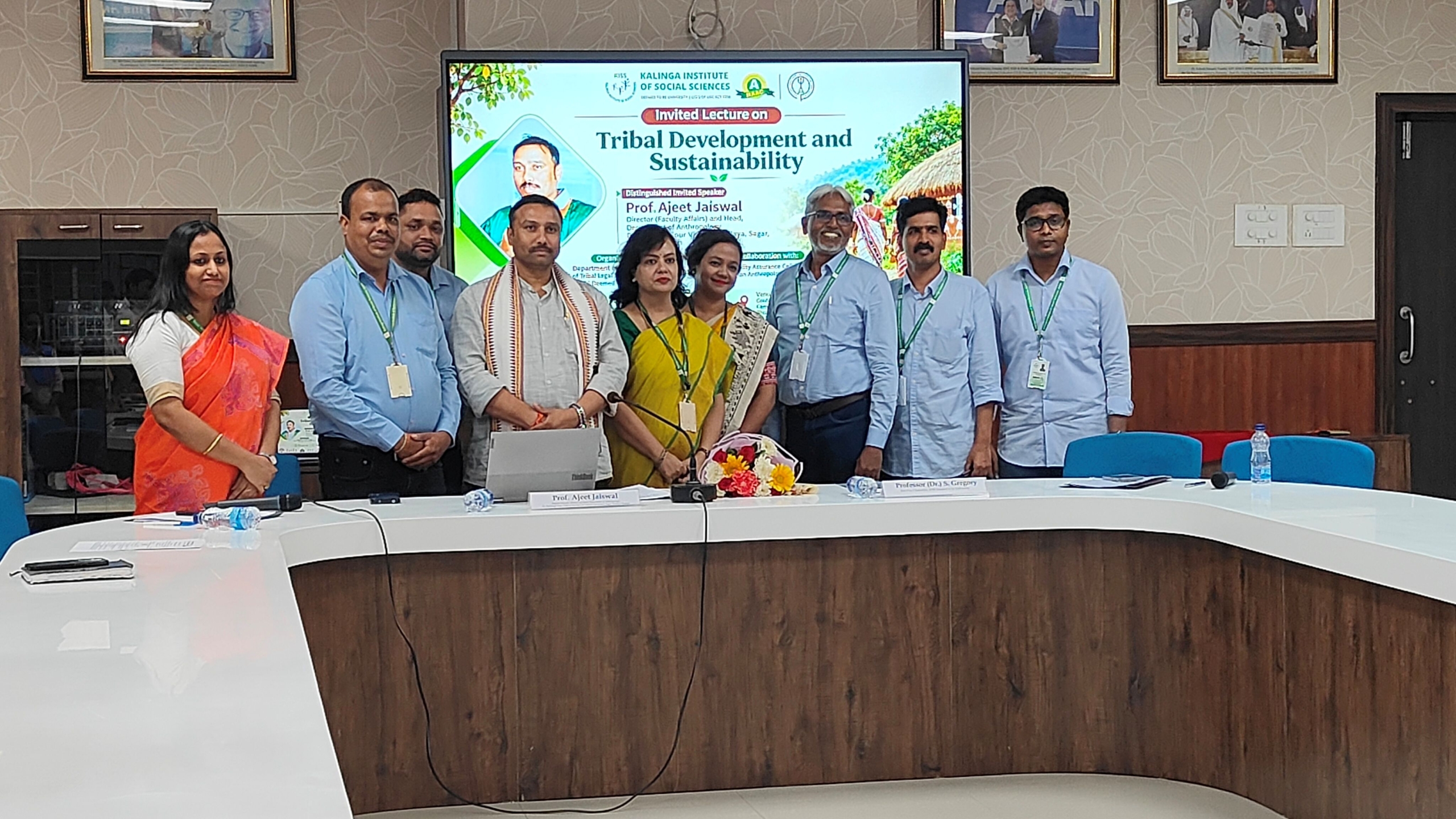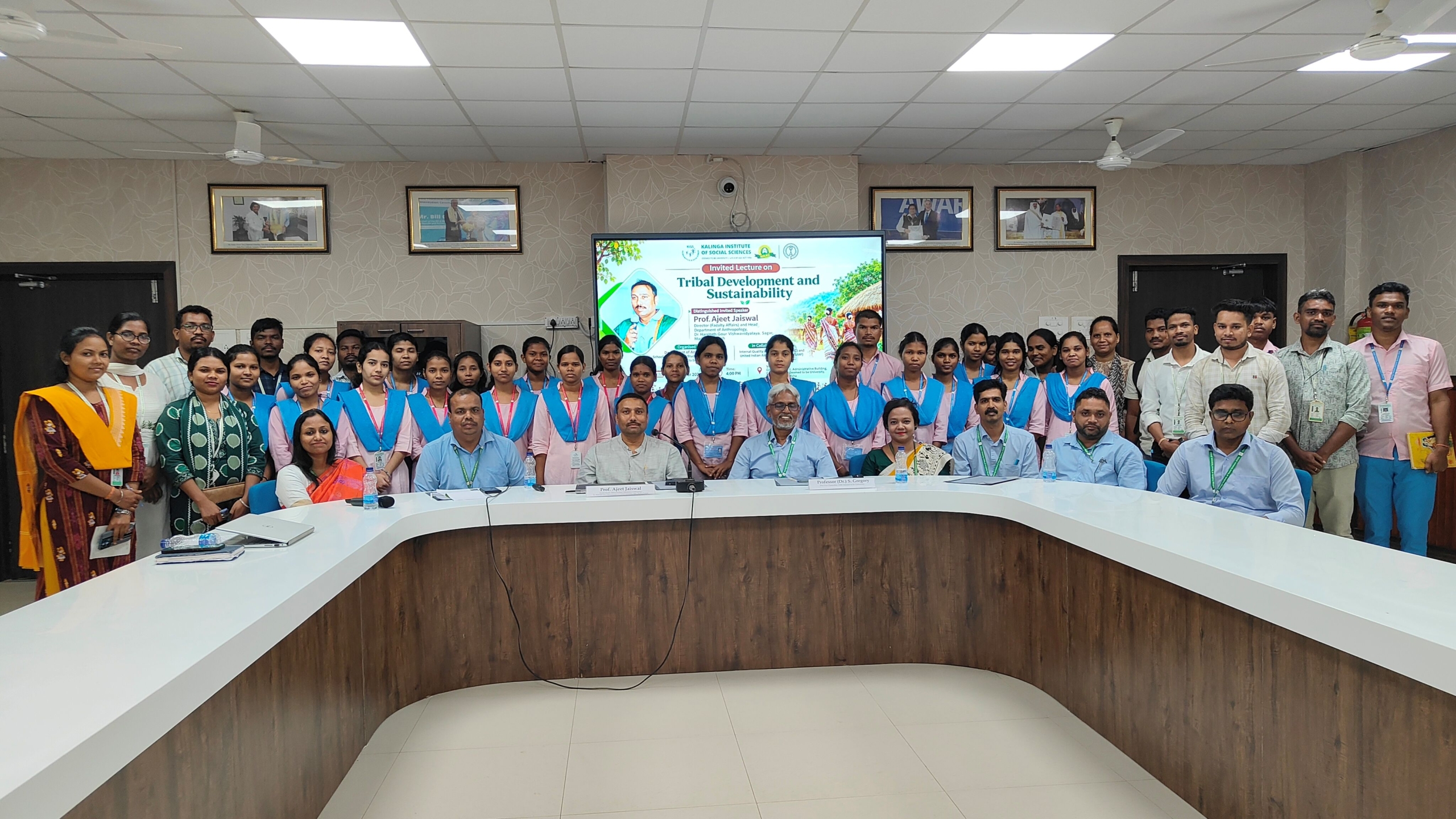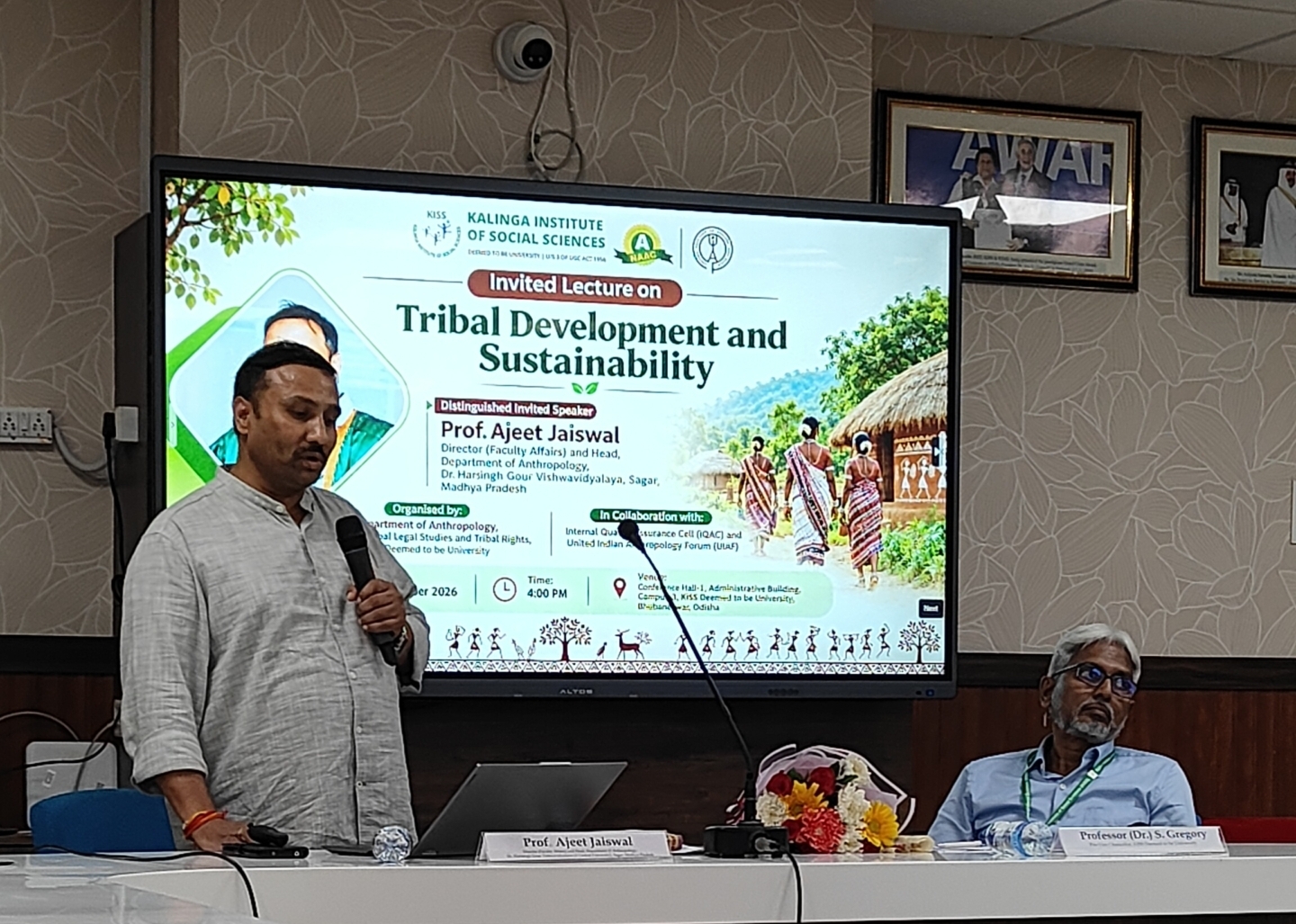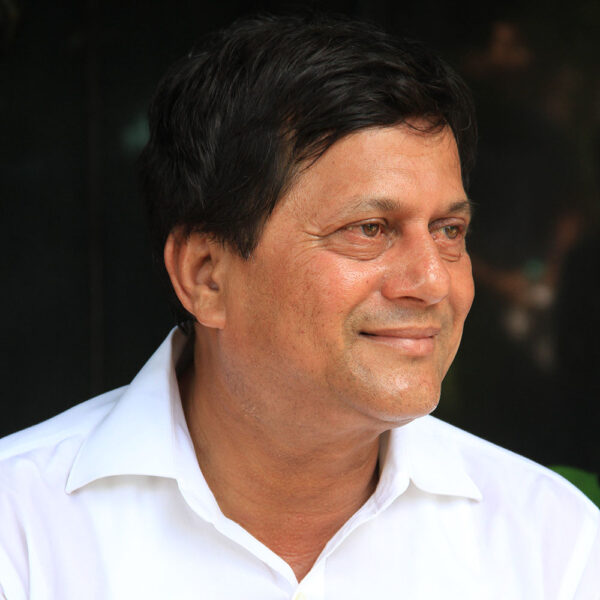
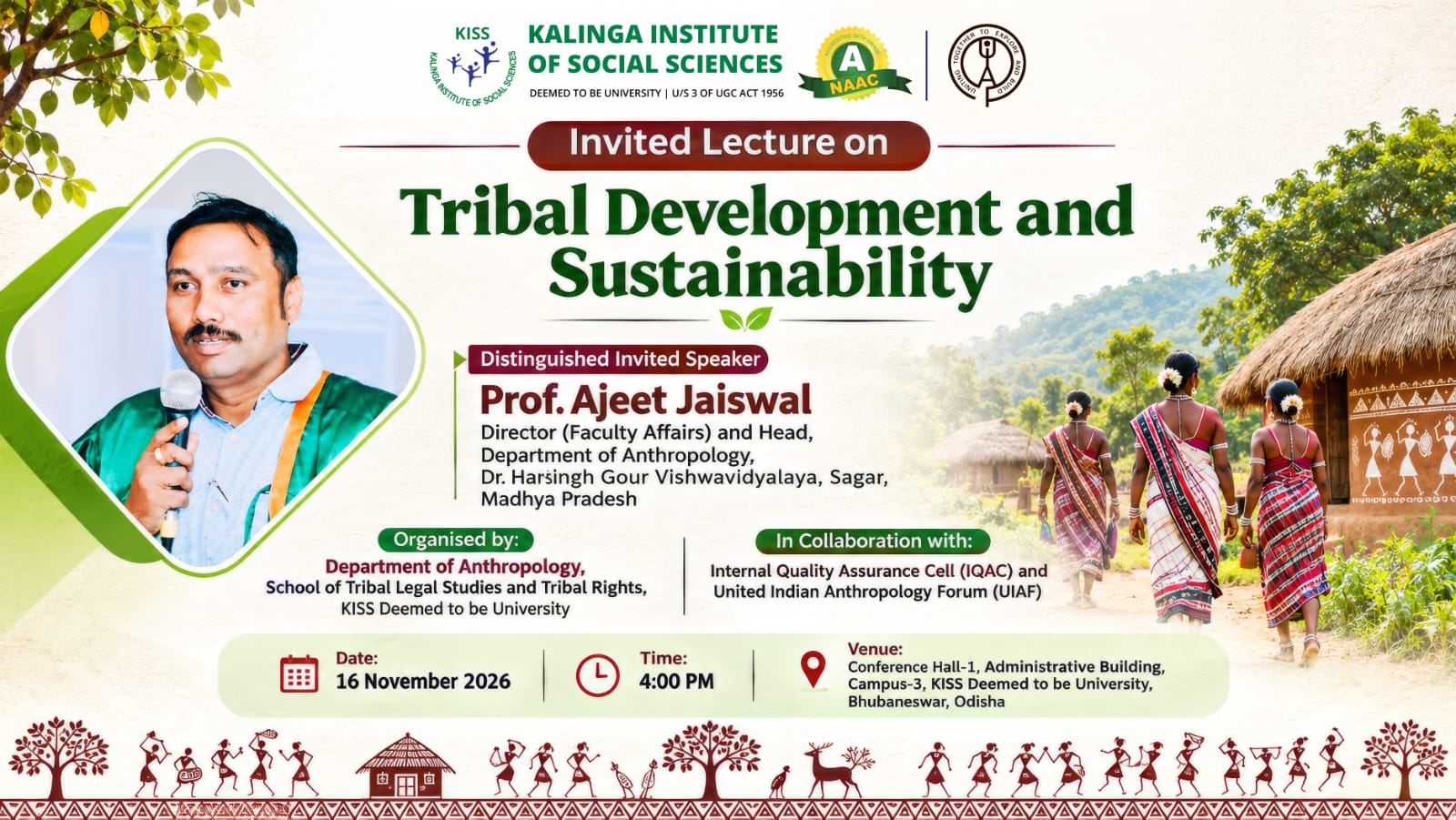
The Department of Anthropology, School of Tribal Legal Studies and Tribal Rights (STLS and TR), Internal Quality Assurance Cell (IQAC) of Kalinga Institute of Social Sciences (KISS) Deemed to be University (KISS-DU), Bhubaneswar, jointly organised a Distinguished Invited Lecture on “Tribal Development and Sustainability” on 16th November 2026, in collaboration with the United Indian Anthropology Forum (UIAF). The lecture was delivered by Prof. (Dr.) Ajeet Jaiswal, Director (Faculty Affairs) and Head, Department of Anthropology, Dr. Harisingh Gour Vishwavidyalaya, Sagar. The programme was moderated by Dr. Anindita Nayak, Assistant Professor, Department of Anthropology, KISS-DU, and was attended by students, research scholars and faculty members of the University.
While delivering the Welcome Address, Dr. Pragyan Mohanty, Associate Professor and Dean, School of Tribal Legal Studies and Tribal Rights, welcomed the esteemed speaker, senior functionaries, faculty members and students. Describing the theme as both significant and timely, she observed that tribal development is not merely about economic progress but about dignity, rights and equality, and that the students present were themselves part of that developmental process. With its doctoral, postgraduate and undergraduate scholars, she said, KISS-DU is a place where tribal development is “in progress”. She added that anthropology, with its focus on indigeneity and human development, is especially well placed to engage with the subject.
Dr. Manoranjan Mohapatra, Assistant Professor and Head, Department of Anthropology, KISS-DU, introduced the resource person. Prof. Jaiswal received his bachelor’s, master’s and doctoral degrees from the University of Delhi and served at Pondicherry University and the Central University of Tamil Nadu before his present appointment. His research spans biological anthropology of health, forensic anthropology, occupational and public health, human genetics, nutritional anthropology, demography, sports anthropology, environmental health, and anthropology and climate change, linking anthropological knowledge with questions of human well-being, community life and sustainable development.
Prof. Jaiswal framed his lecture around “Gen Z, Tribal Culture and Sustainability in Development”, addressing himself directly to the young audience. He opened with the Prime Minister’s observation that the world can learn a great deal about sustainable development from Adivasi culture, and that such learning may offer solutions to global problems such as climate change and global warming. Tracing the history of terms such as Girivasi, Vanvasi, Pahadi, Adim Jati and Adivasi, he described tribes as among the oldest inhabitants of the subcontinent: communities without a conventional state form or sharp class divisions, whose rich customs are carried by oral tradition. India, he noted, is home to about 104 million tribal people, around 8.6 per cent of its population, spread across some 705 communities. Yet, alongside celebrated growth in GDP, infrastructure and digital transformation, these communities continue to face severe socio-economic inequalities that demand attention and action.
Relating culture to the 17 Sustainable Development Goals, he distinguished a functional dimension of culture (cultural goods, services and industries) from a constitutive dimension (the norms, beliefs and values that shape how development is lived). Holistic tribal development, he argued, calls for a transdisciplinary approach that builds social, natural and financial capital for livelihoods, food security and well-being. Tribal culture, with its communal living, closeness to nature, self-sufficiency, spiritual belief and folk art and craft, already embodies many of these principles, as seen in practices such as the protection of sacred groves.
Five lessons Gen Z can learn from tribal communities
- Living close to nature. Tribal communities live in harmony with forest, river and land, valuing balance over consumption. In a fast-paced digital world, reconnecting with nature supports mental peace, health and well-being.
- Strong community bonding. Strong communities create stronger individuals and healthier societies.
- Respect for traditions. Traditions are a source of wisdom, identity and pride; modernity need not mean forgetting one’s roots.
- Sustainable lifestyle. Careful use of resources and little waste offer lessons in an age of climate change and pollution; small, mindful daily choices add up.
- Identity with pride. Tribal communities celebrate their language, dress, music and customs with confidence; embracing one’s identity builds self-worth and authenticity.
Linking tribal culture to sustainable development, he highlighted respect for the natural environment, conservation of resources, community-based decision-making, intergenerational knowledge sharing, biodiversity, renewable energy, protection of water resources and regenerative agriculture. These practices, however, are under strain from insecure land rights, discrimination, climate change and environmental degradation, socio-economic marginalisation, cultural assimilation, limited political representation and health challenges.
Among government responses, he discussed the Tribal Cooperative Marketing Development Federation of India (TRIFED), established in 1987 under the Ministry of Tribal Affairs (MoTA), which helps tribal artisans and forest-produce gatherers reach national and international markets where their crafts and herbal knowledge are valued far more than in local markets. He also referred to Tech for Tribals, schemes for particularly vulnerable tribal groups, support to tribal research institutes and festivals, pre-matric, post-matric and overseas scholarships, the National Scheduled Tribes Finance and Development Corporation, vocational training, and the marketing mechanism for minor forest produce.
While summing up the session, Prof. Jaiswal returned to his opening theme: tribal lifestyles, being largely self-sustaining, offer practical solutions to climate change and global warming, and valuable lessons for sustainable development, particularly in biodiverse regions and wherever development threatens the natural environment.
In his concluding remarks, Prof. (Dr.) S. Gregory, Pro-Vice Chancellor, KISS-DU, thanked the speaker for an engaging and intellectually stimulating lecture. He said the discussion had shown tribal communities to be not mere beneficiaries of development but knowledge holders, custodians of biodiversity and cultural heritage, and active partners in shaping a sustainable future. Progressive legislation, he stressed, must translate into rights realised in the everyday lives of communities. Addressing postgraduate students, he recalled M. N. Srinivas’s image of the anthropologist as “thrice born”: born into one’s own community, reborn in the field, and born again on returning to reflect. He urged Gen Z to move beyond competition and excessive consumerism towards compassion, collective responsibility and ecological consciousness, and to make meaningful KISS’s unique opportunity to connect indigenous wisdom with modern education, science and technology. He left the audience with three thoughts:Learn from tribal communities rather than merely studying them; Promote development without compromising identity and dignity and build a future in which economic progress, social justice, cultural diversity and ecological sustainability go hand in hand.
Dr. Manoranjan Mohapatra, Head, Department of Anthropology, proposed the vote of thanks.