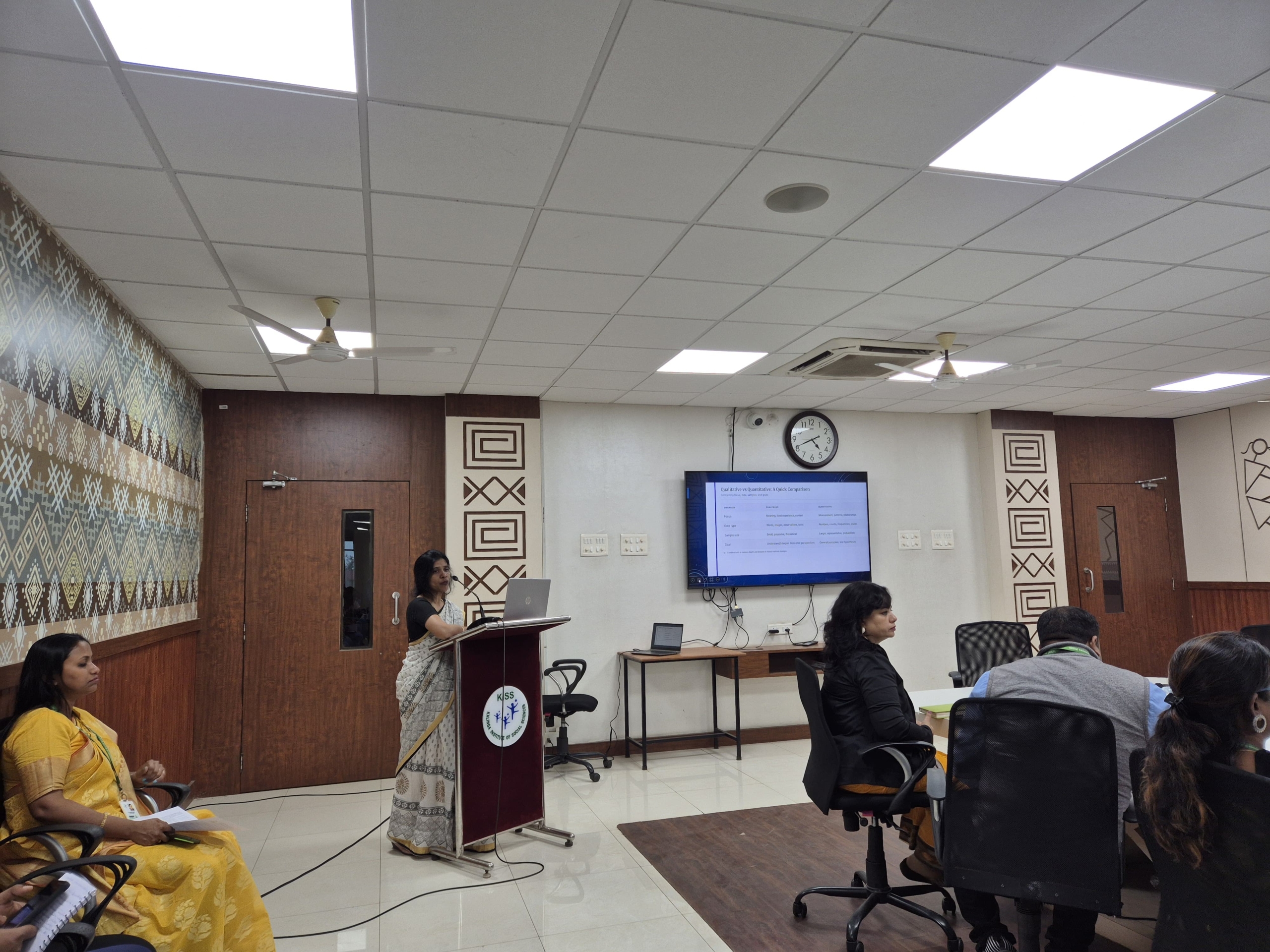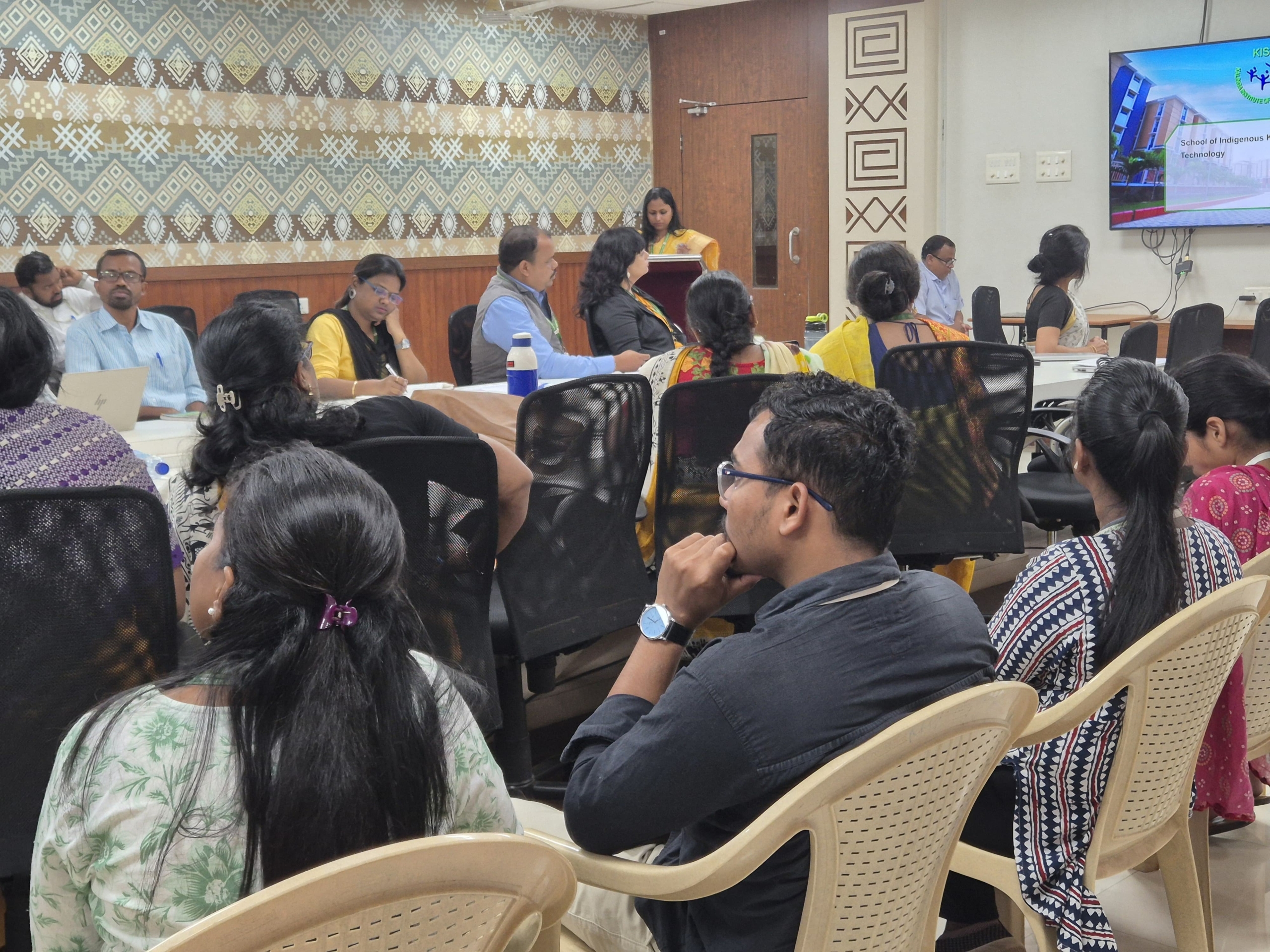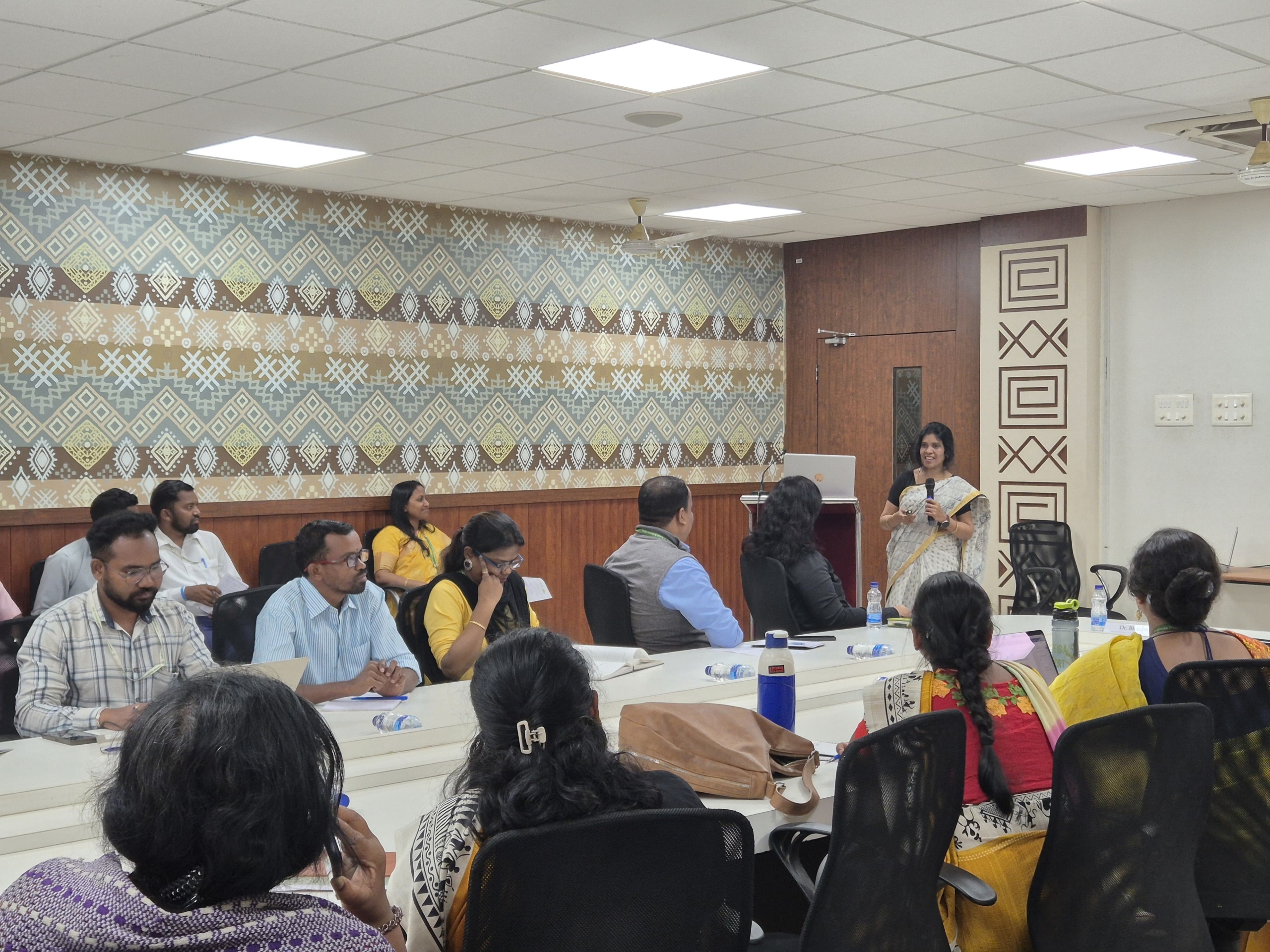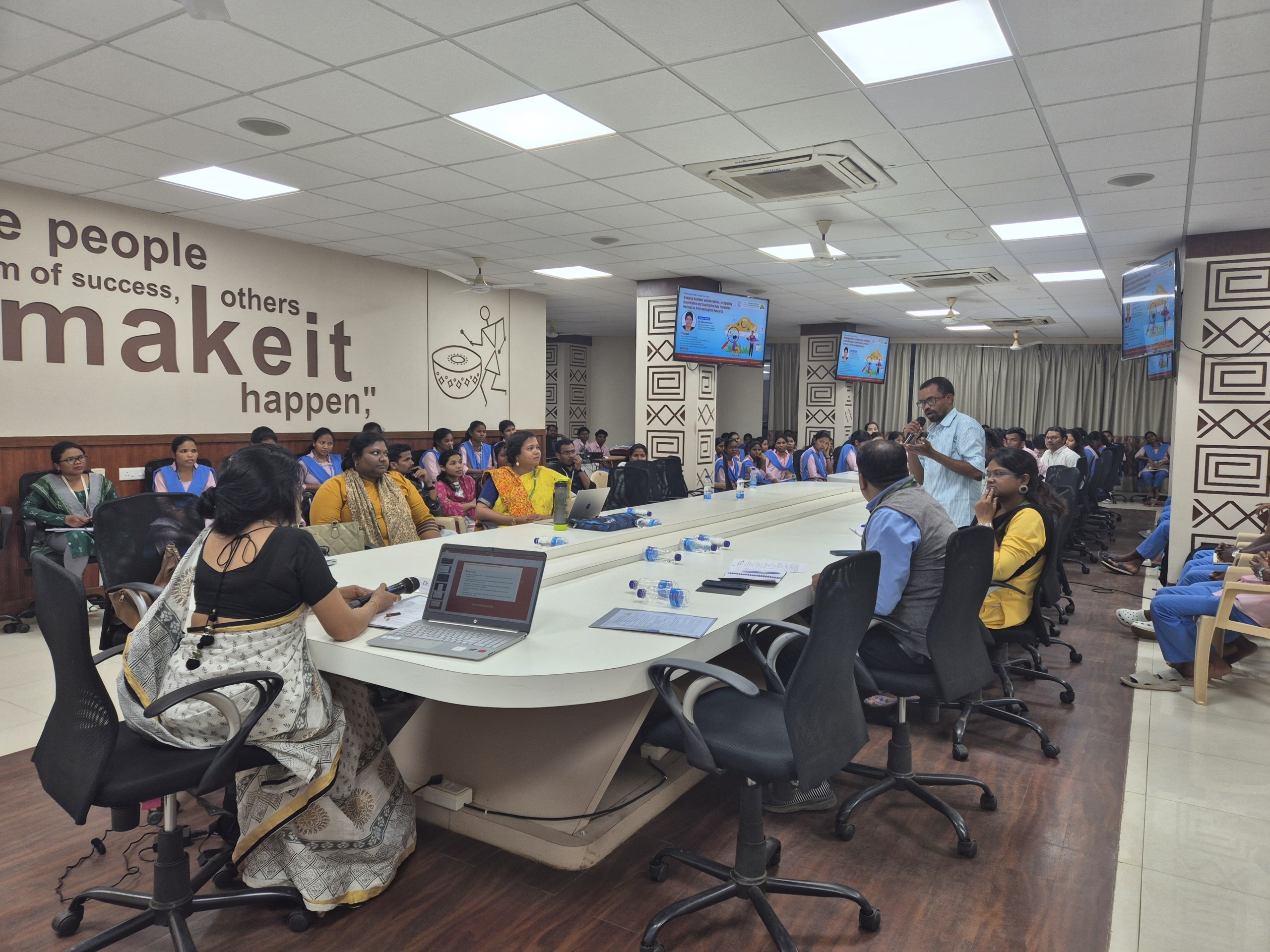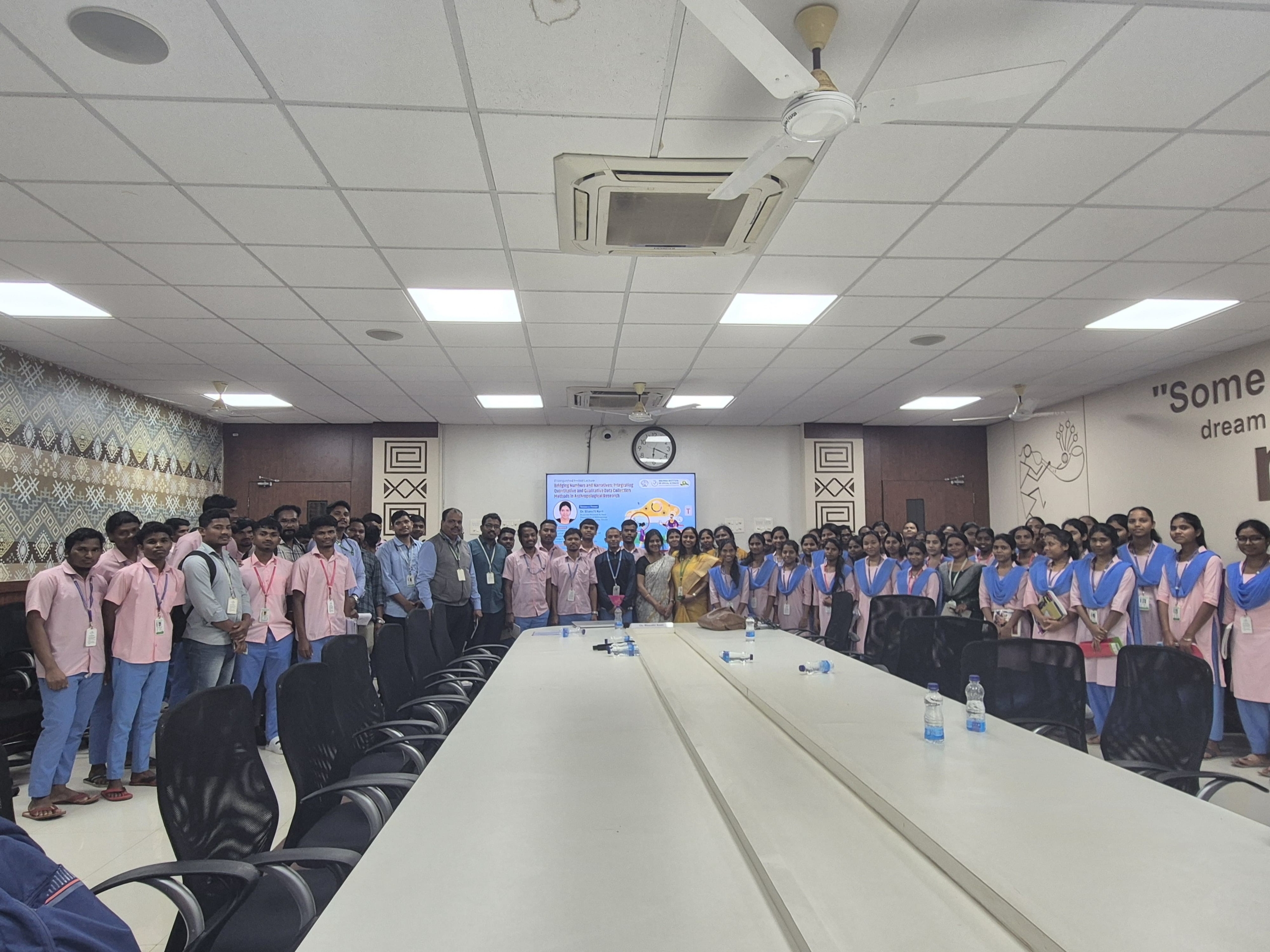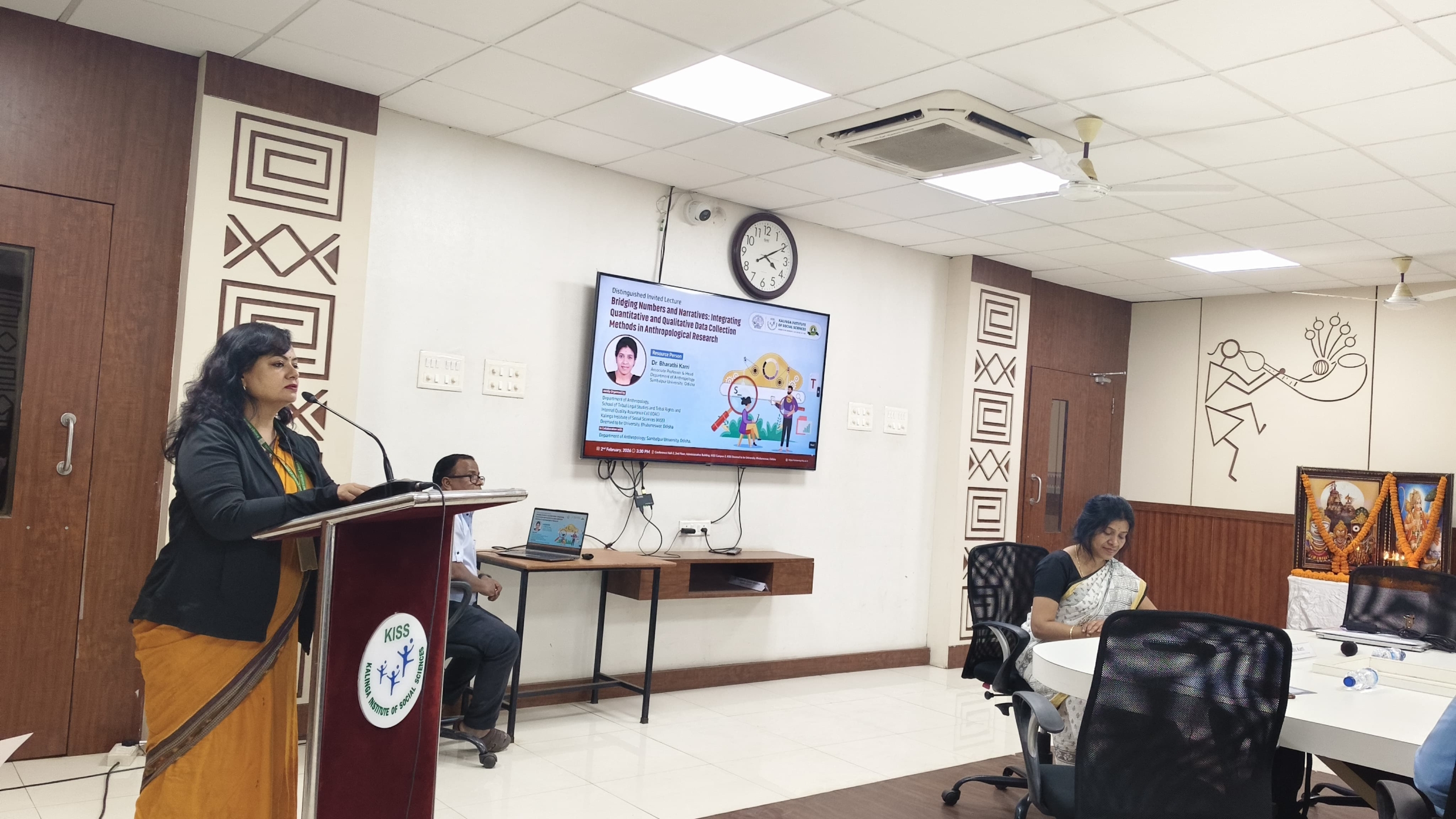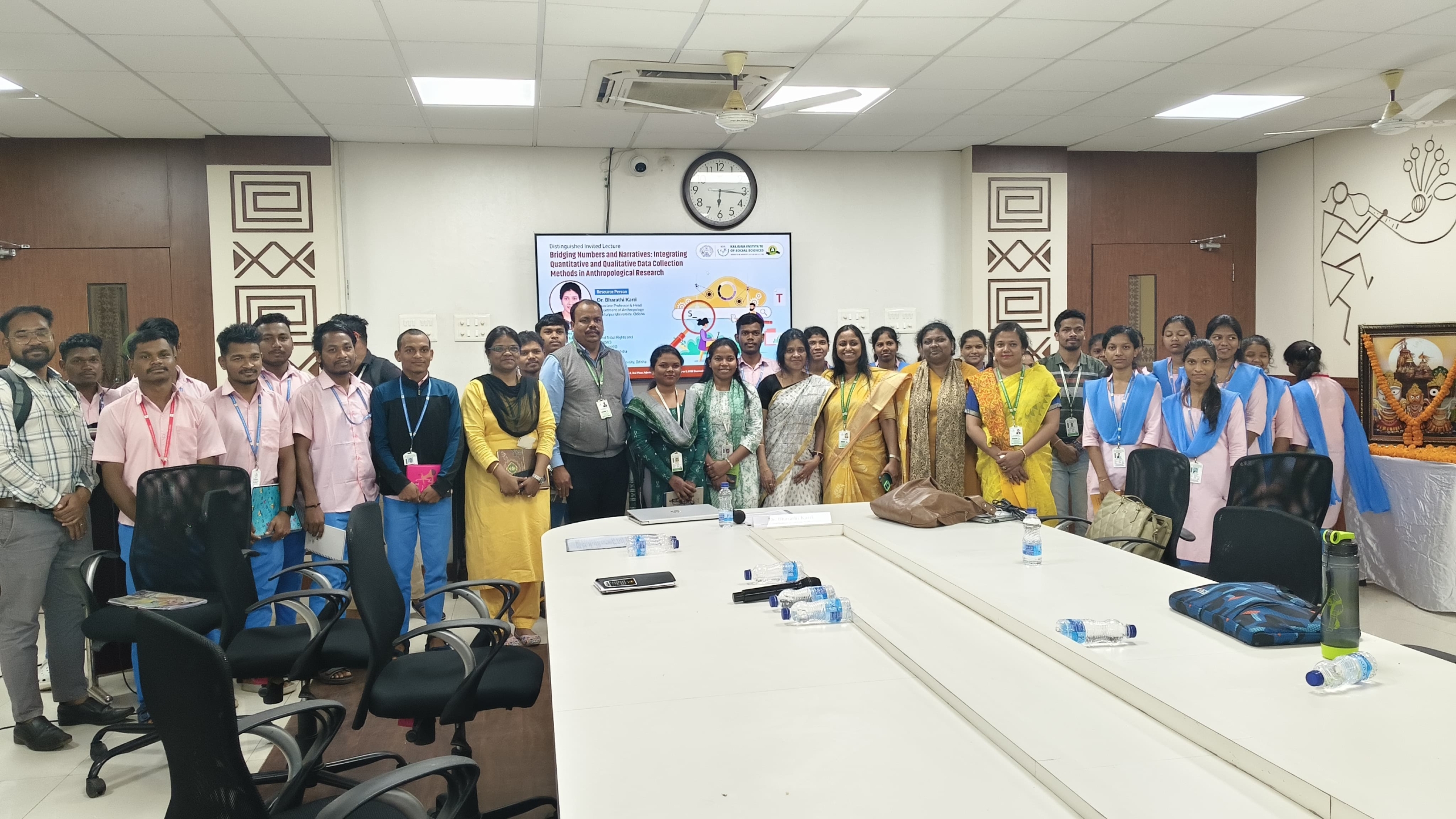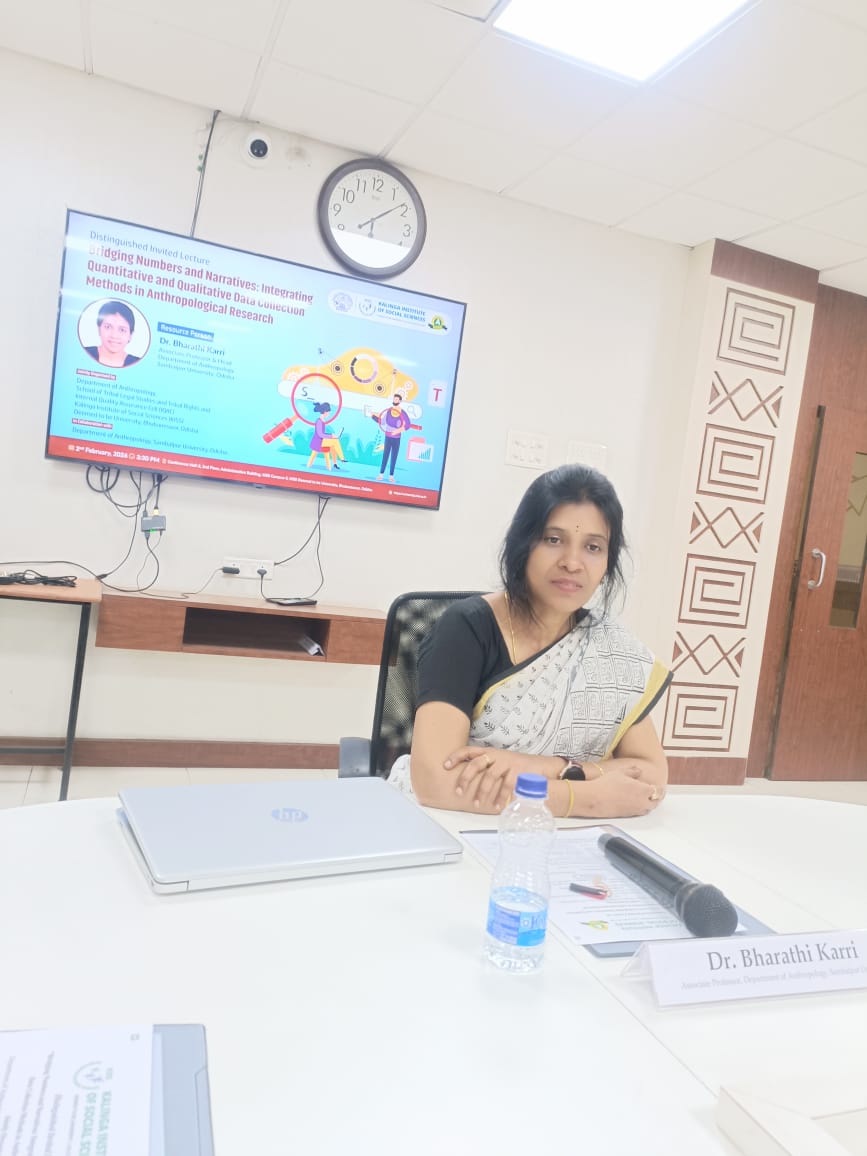
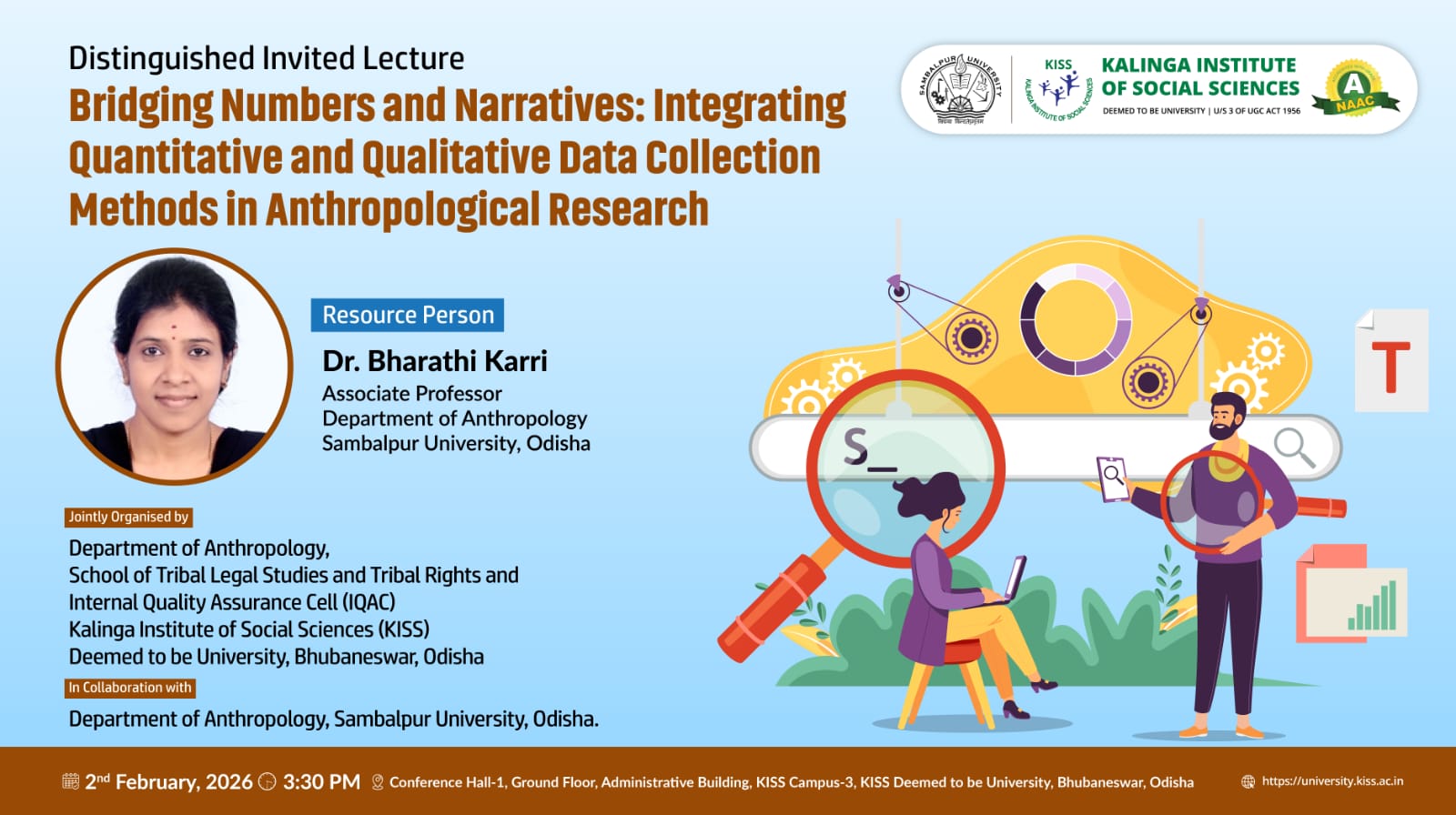
KISS-DU organized a Distinguished Invited Lecture titled “Bridging Numbers and Narratives: Integrating Quantitative and Qualitative Data Collection Methods in Anthropological Research” on 2nd February 2026. The lecture was jointly organized by the Department of Anthropology, School of Tribal Legal Studies and Tribal Rights, and the Internal Quality Assurance Cell (IQAC), KISS Deemed to be University, in collaboration with the Department of Anthropology, Sambalpur University, Odisha.
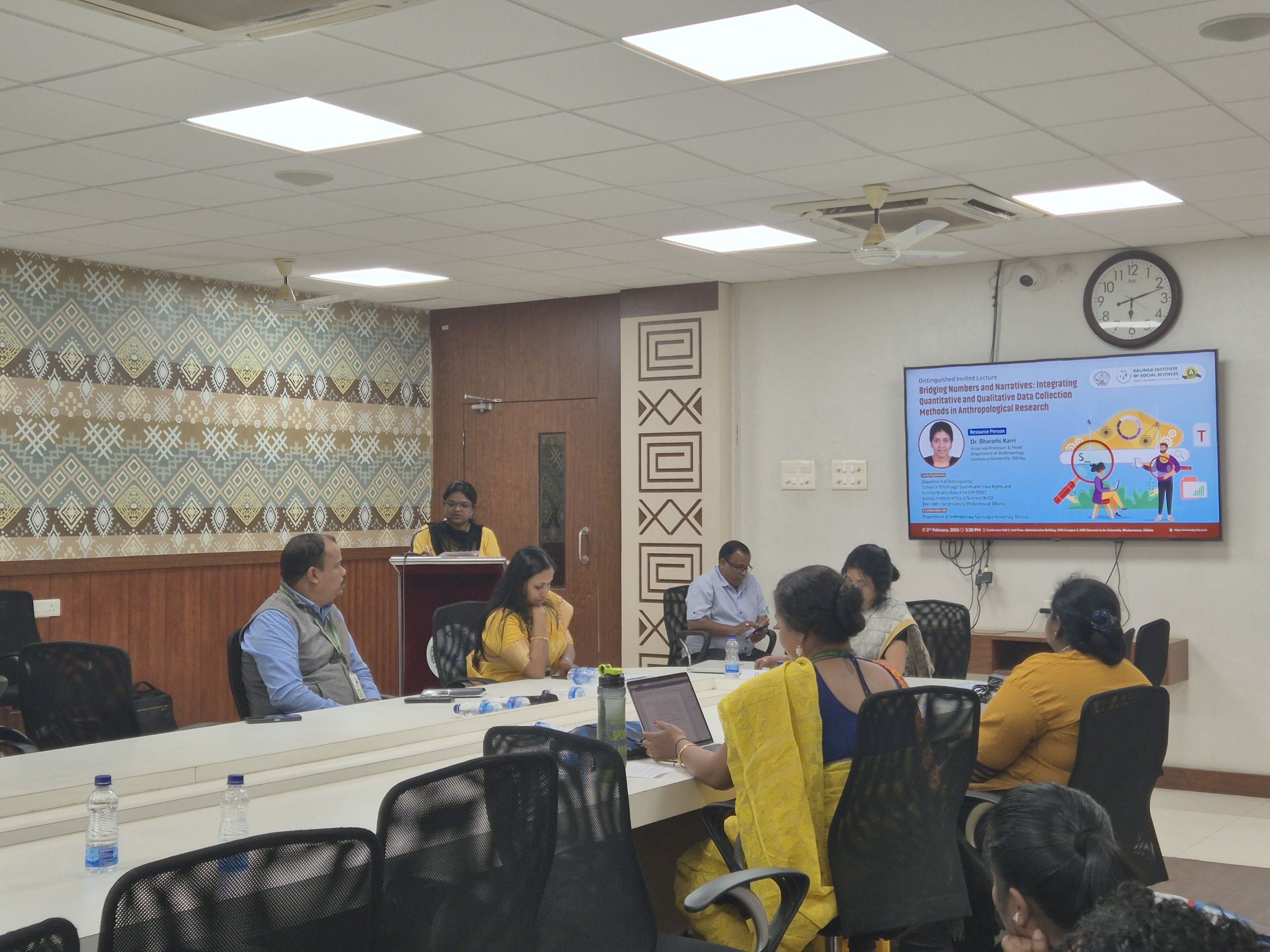
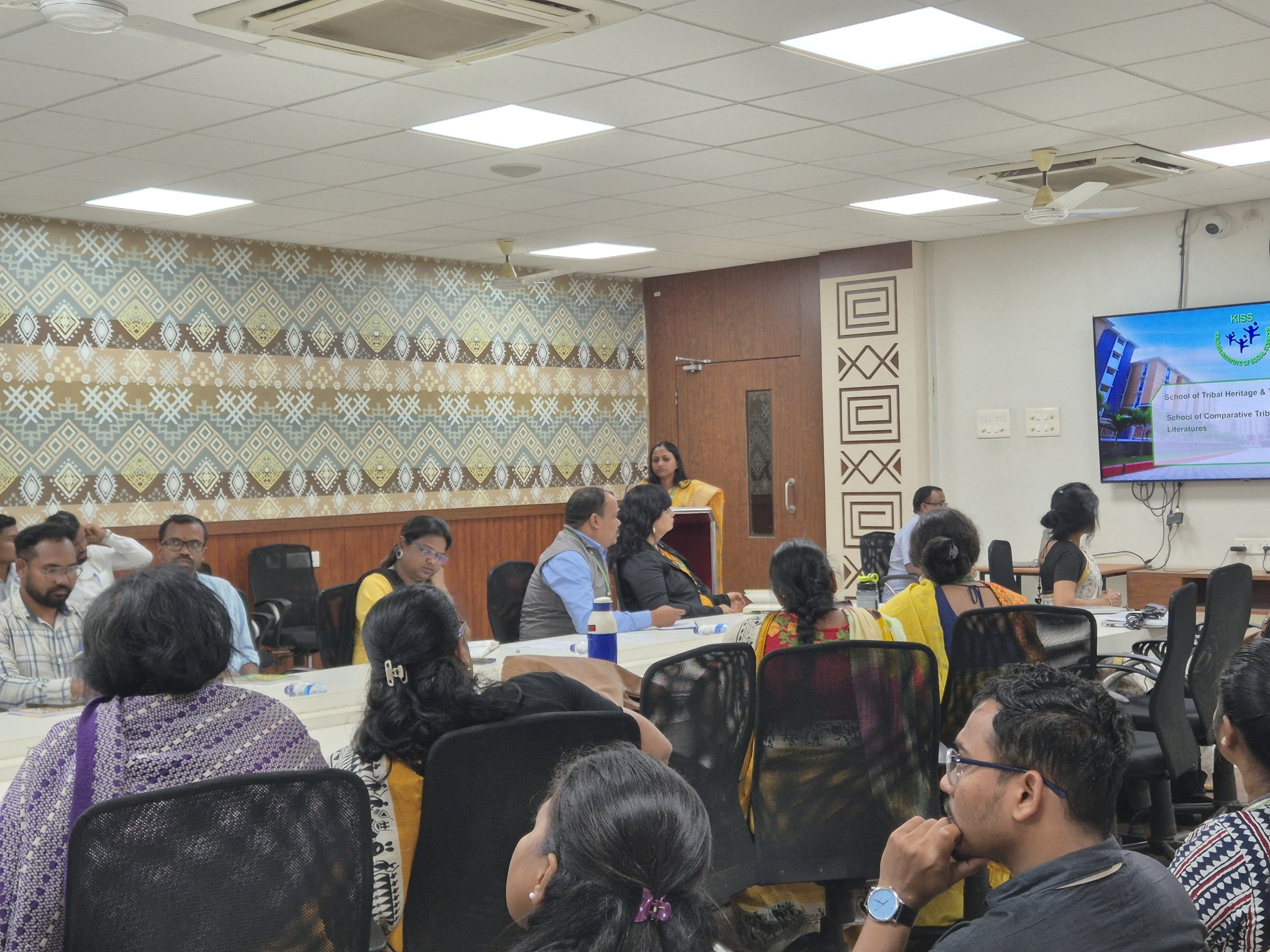
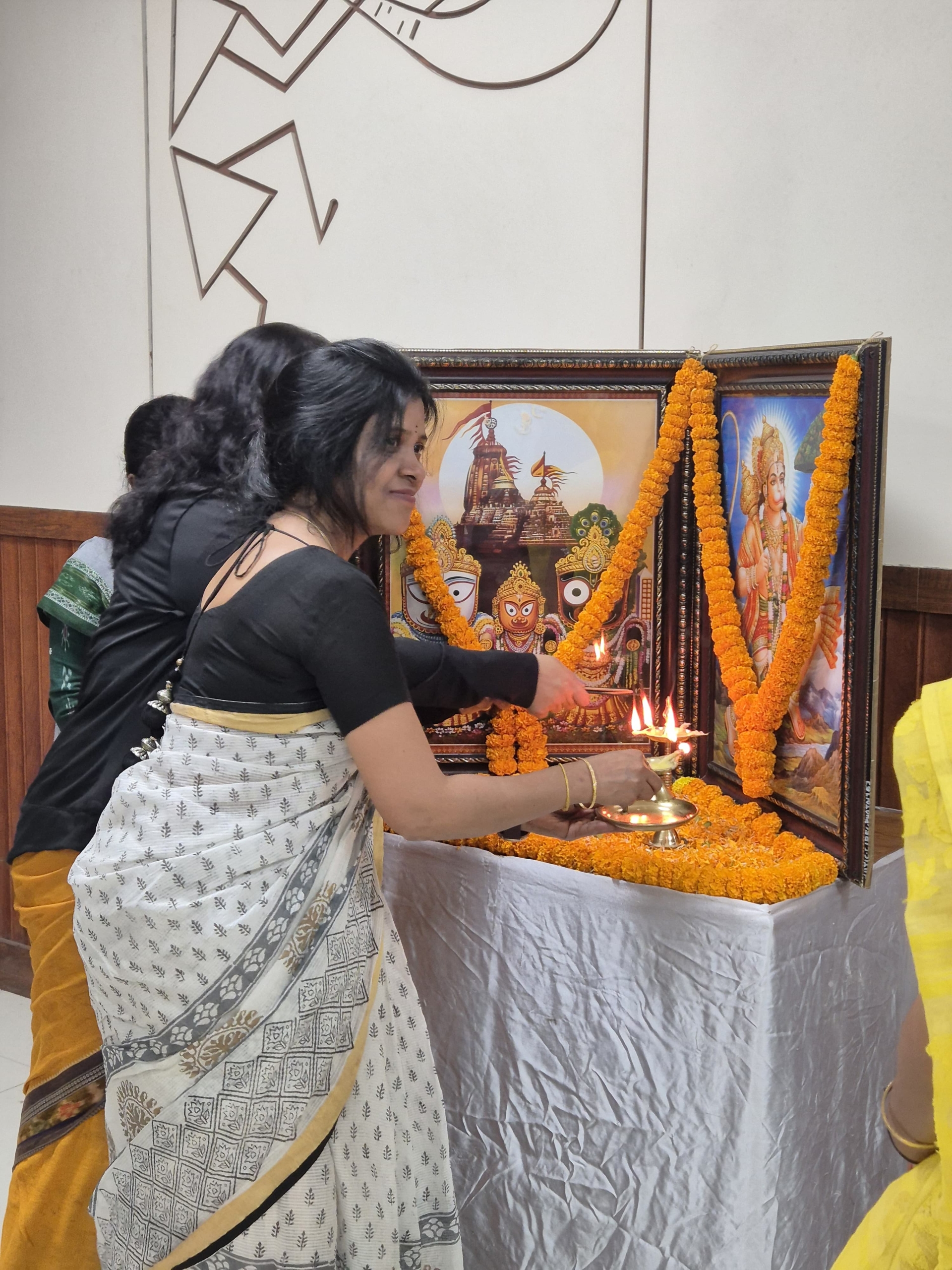
The programme began with introductory remarks by Dr. Anindita Nayak, Moderator of the session, who welcomed the speaker Dr. Bharathi Karri, Associate Professor, Department of Anthropology, Sambalpur University, and dignitaries, including Dr. Pragyan Mohanty, Dean and Associate Professor, School of Tribal Legal Studies and Tribal Rights; Dr. Manoranjan Mohapatra, Head and Assistant Professor, Department of Anthropology; Dr. Manoj Kumar Behera, Associate Professor; Dr. Madhusmita Sahoo Assistant Professor and Rapporteur Dr. Priyanka Kanrar, Assistant Professor, Department of Anthropology, KISS-DU.
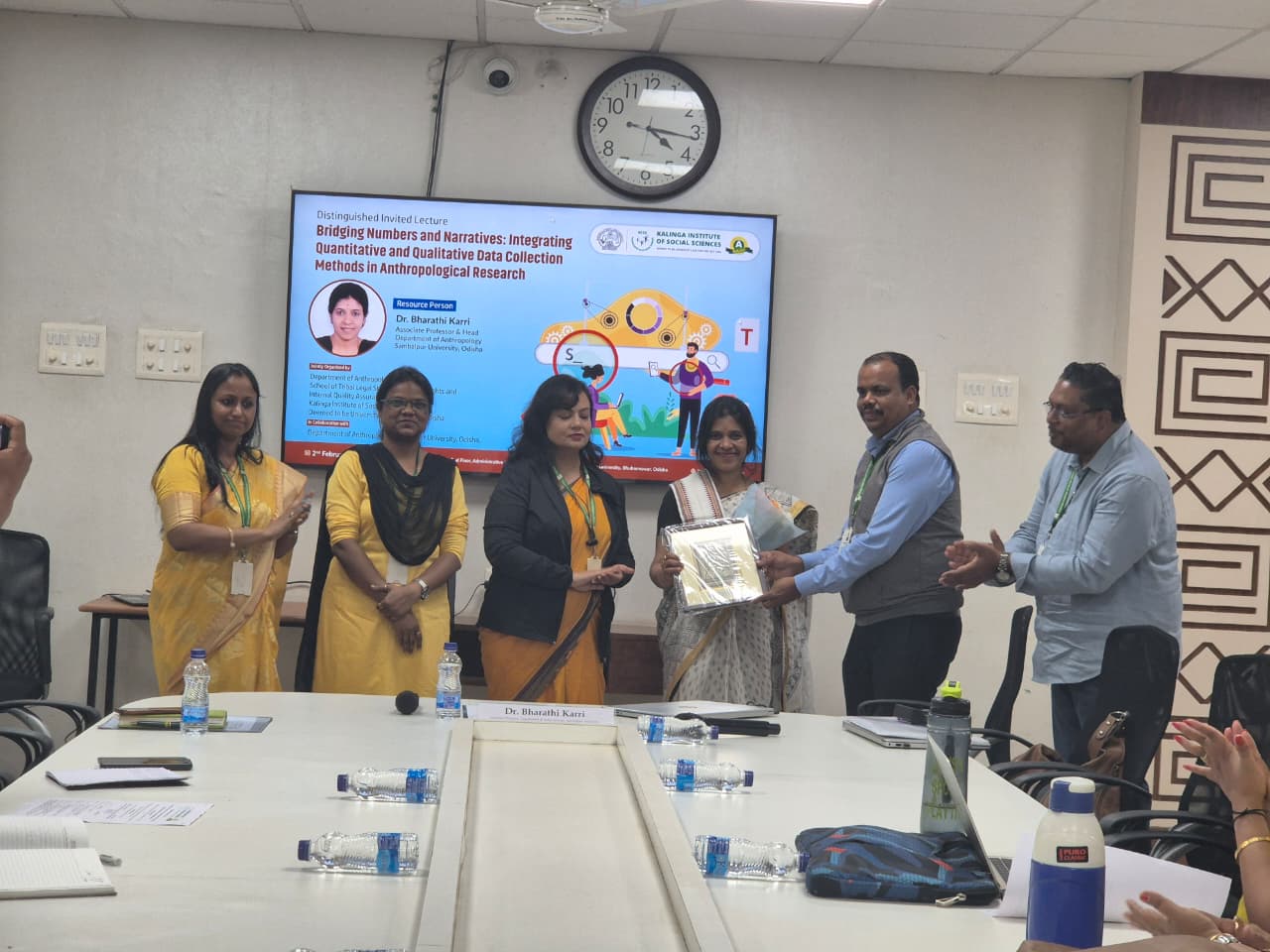
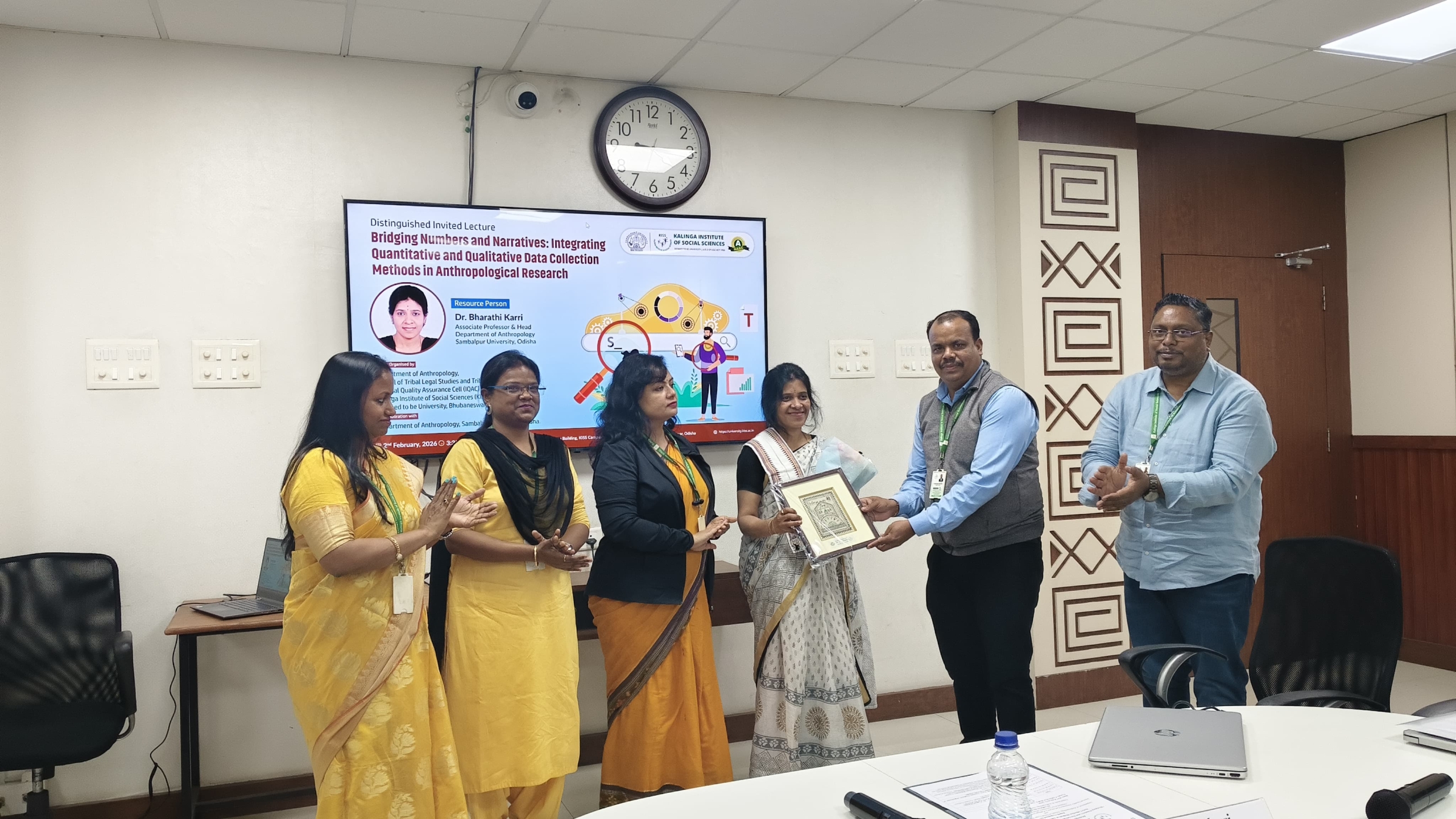
In her welcome address, Dr. Pragyan Mohanty highlighted the relevance of the lecture theme and its significance in contemporary anthropological research. Dr. Anindita Nayak then formally introduced the invited speaker, outlining Dr. Bharathi Karri’s academic background, research contributions, and expertise in anthropological methodology. The speaker was formally felicitated by Dr. Pragyan Mohanty, Dr. Arpana Premi Lina Oraon, Associate Professor and Director (Research), KISS-DU, Dr. Manoj Kumar Behera, and Dr. Manoranjan Mohapatra.
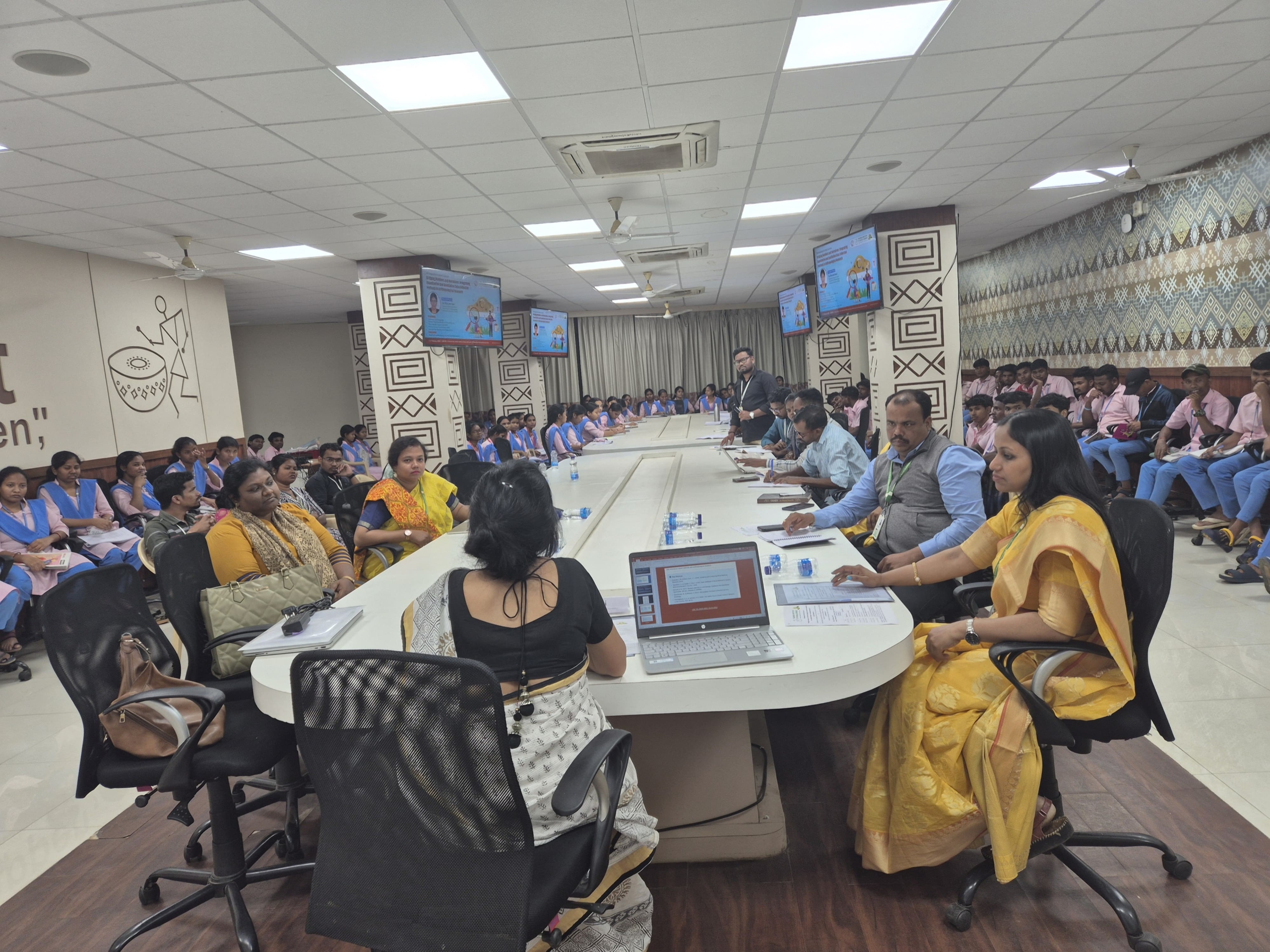
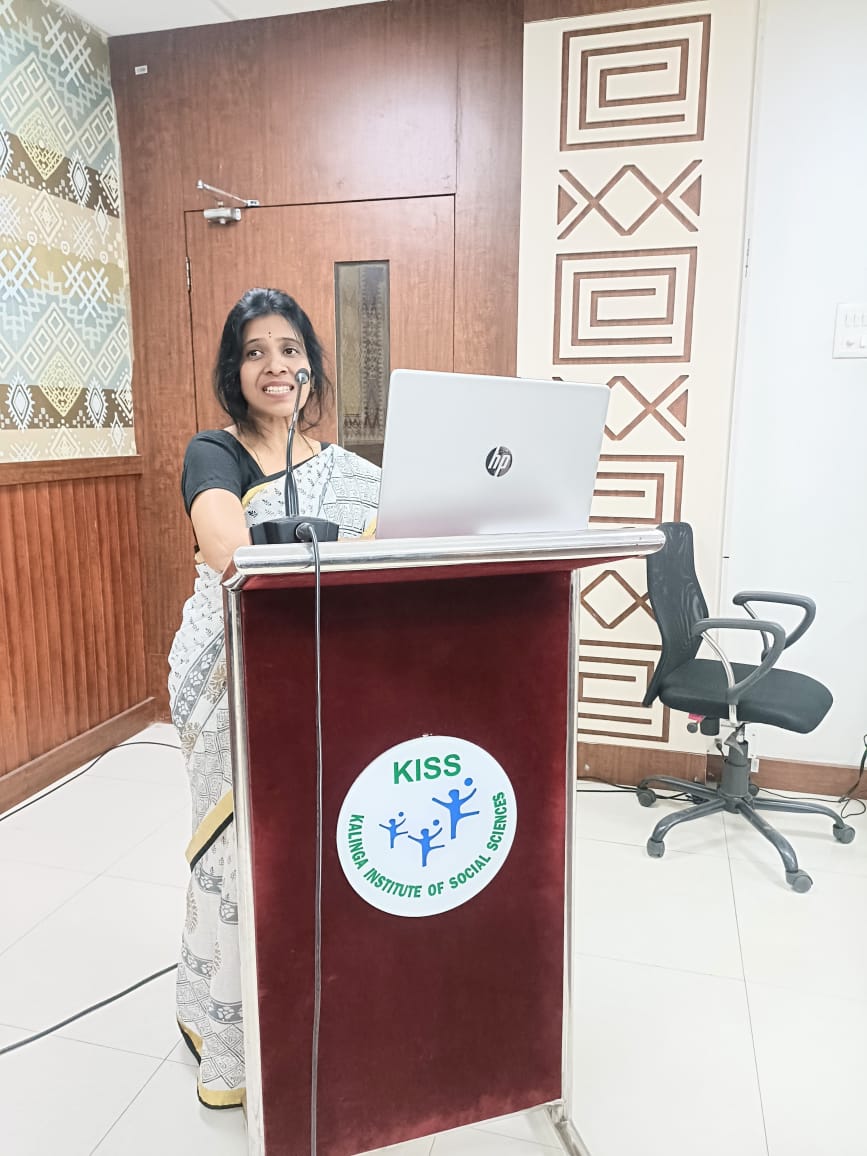
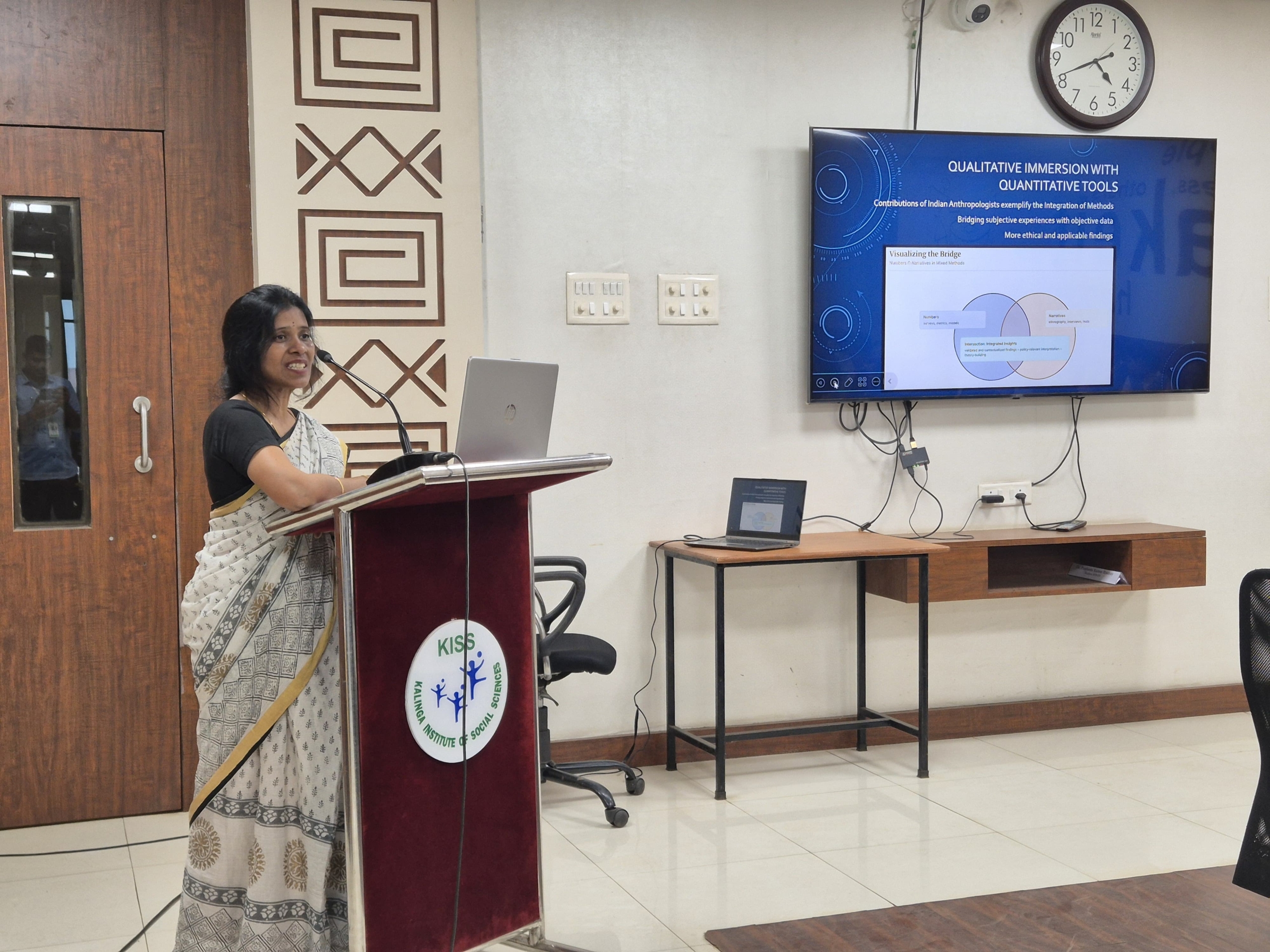
In her lecture, Dr. Bharathi Karri highlighted the importance of integrating qualitative narratives and quantitative data in anthropological research to achieve a holistic understanding of social realities. She explained how narratives capture context, meaning, and emic perspectives, while quantitative data enable comparison and generalization. Tracing the historical evolution of anthropology, she referred to its 18th-century roots and discussed foundational concepts such as emic and etic approaches, participant observation introduced by B. K. Malinowski, and Clifford Geertz’s concept of thick description. Dr. Karri elaborated on the role of the anthropologist, emphasizing reflexivity, rapport establishment, long-term field immersion, and ethical challenges in fieldwork. She discussed key qualitative and quantitative data collection methods, hypothesis formulation, data saturation, and the relevance of objectivity in research. Emphasizing mixed-method approaches, she highlighted their advantages such as triangulation, validation, and policy-relevant interpretation, citing contributions of Indian anthropologists including D. N. Majumdar, B. K. Roy Burman, Irawati Karve, and N. K. Bose to demonstrate effective methodological integration.
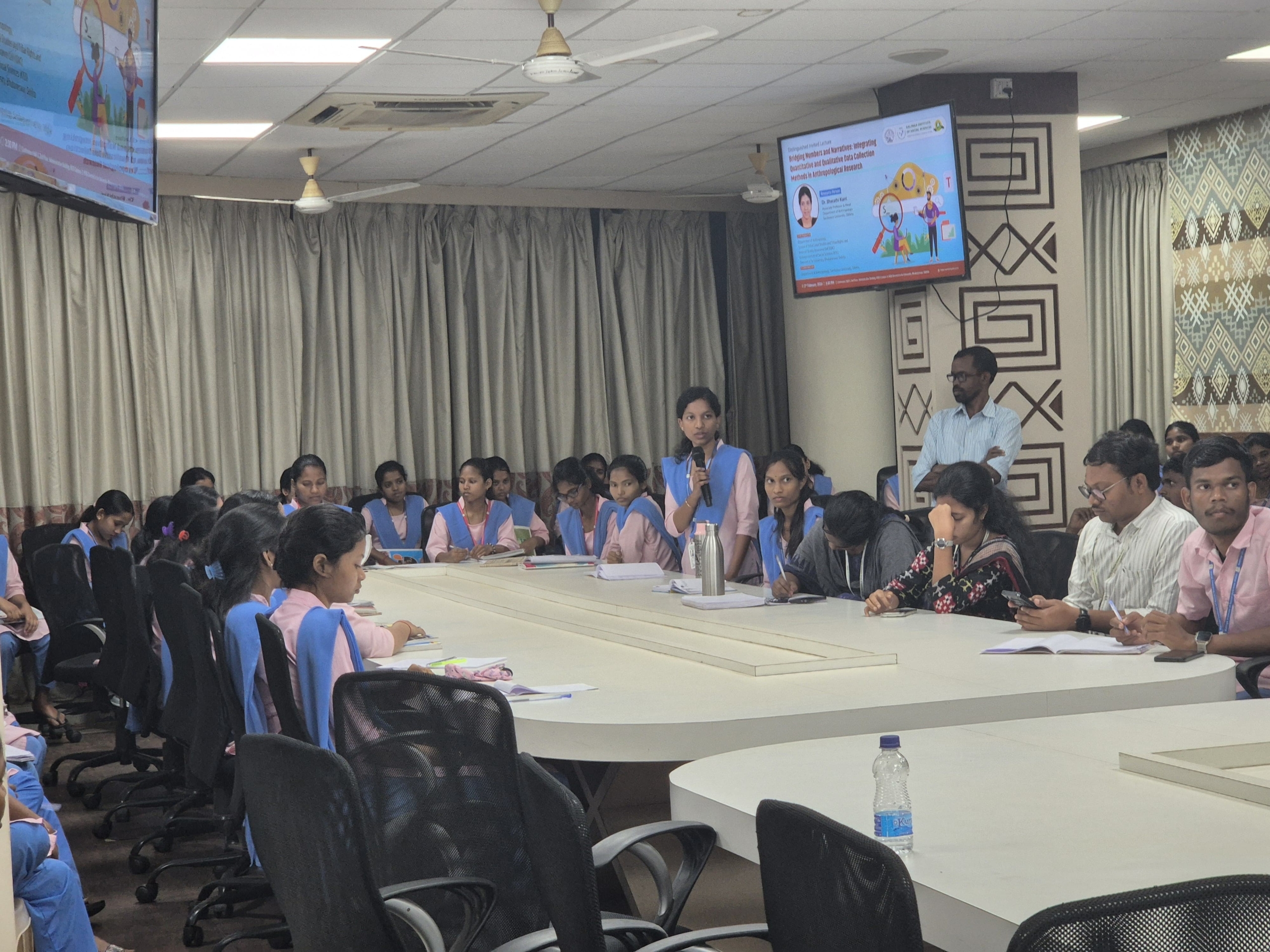
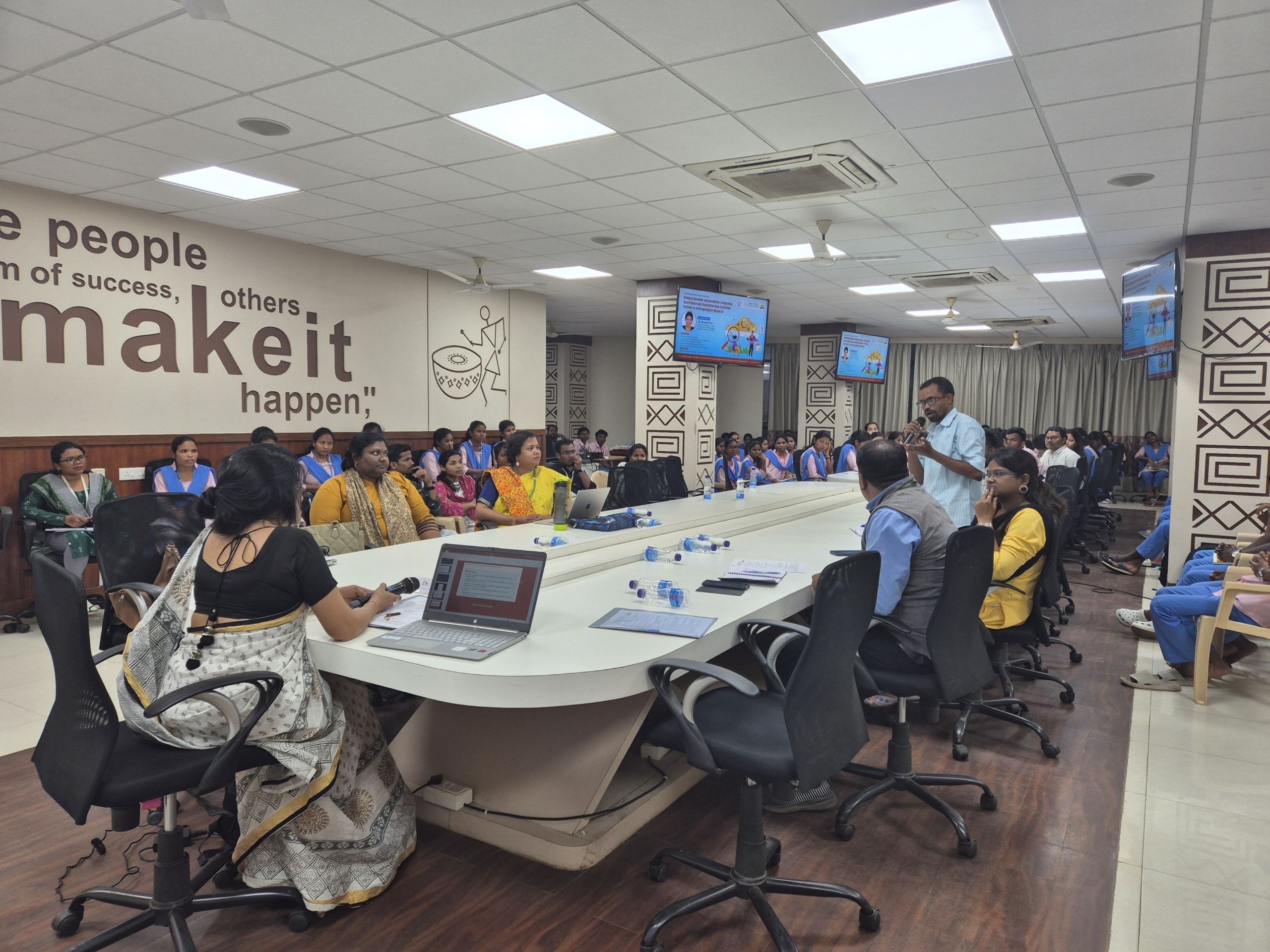
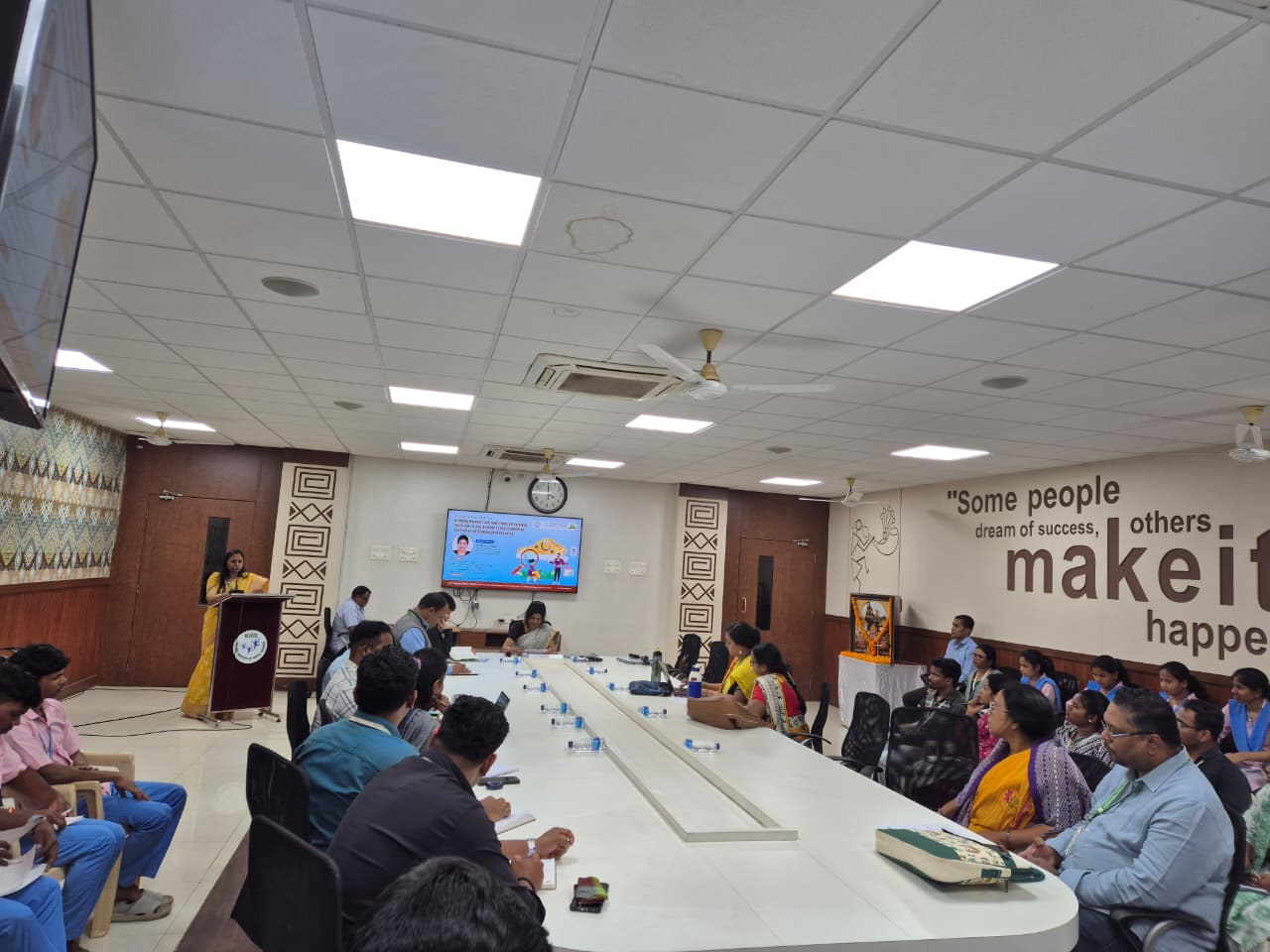
The lecture was followed by an interactive question-and-answer session, during which faculty members and students raised queries on research design related to tribal displacement and migration, rapport establishment in linguistically diverse field settings, data analysis strategies, research reliability and consistency, and the transformation of qualitative data into quantitative forms. Dr. Bharathi Karri responded to all the questions with clarity and scholarly insight.
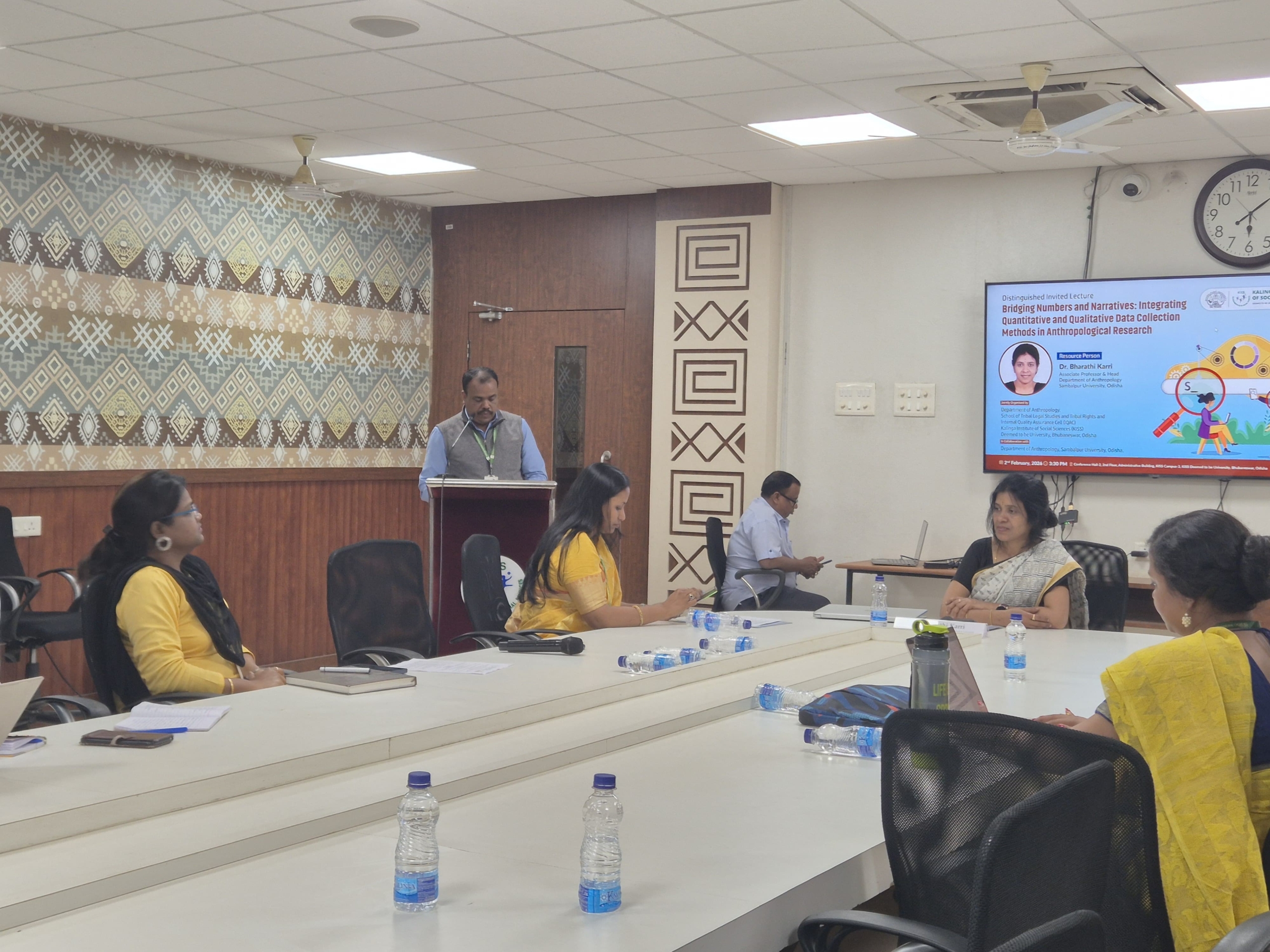
The programme concluded with concluding remarks by Dr. Manoranjan Mohapatra, who emphasized the academic value of the lecture and its relevance for students and researchers. The event concluded with a vote of thanks by Dr. Arpana Premi Lina Oraon, Associate Professor and Director (Research), KISS-DU, expressing gratitude to the speaker, organizers, and participants for the successful conduct of the programme.