
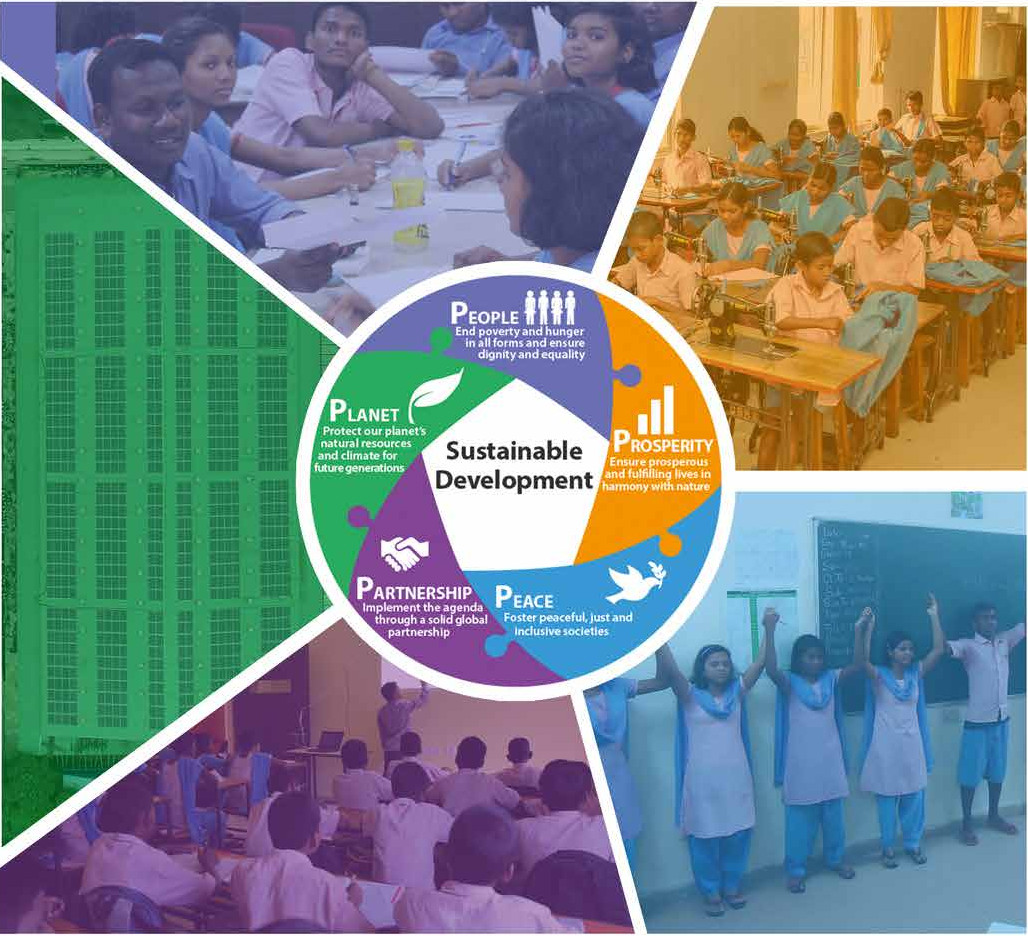
KISS boasts of a Language Lab, in collaboration with the Bernard van Leer Foundation, wherein mother tongue-based multilingual education is imparted to tribal children. Even though 15 out of the 30 districts in Odisha have dense tribal populations, there is no acknowledgement of tribal people in education. In fact, history textbooks do not mention the contribution of tribal people to the freedom movement. There is no appreciation of tribal culture and languages, which creates a sense of inferiority among tribal children. To combat this, the Language Lab encourages education in native languages, besides teaching the English language to the tribal children. This model is also based on the premise that learning and psycho-social development is optimised, if children are taught in their native language. Imparting holistic multidisciplinary education and contributing to the process of self-reliance KISS-DU offers technical assistance for fostering inclusive learning environments and early childhood education through Mother Tongue Based Multi Lingual Education program.
The principle of ‘Prosperity’ finds reflection in the vocational centre being run at the KISS University. It is based on the concept of ‘Earn While You Learn’. The training at the centre links education with productivity, economic development and individual prosperity. In doing so, they ensure sustainable livelihoods. The course designs are based on chemical, appliqué, painting, food processing, tailoring, knitting, and drinking water (to be launched soon). Vocational products included phenyl, hand wash, liquid detergent, tribal paintings, uniforms, etc. The buyers currently include KIIT and KISS, although the Centre is in talks with big suppliers such as Big Bazaar, etc. One-third of the surplus sales’ proceeds are given to students, under KISS’ innovative ‘Earn While you Learn’ programme that provides supplementary income to students while encouraging them to study. Vocational classes are held for an hour everyday.
United Nations Population Fund (UNFPA) supports the Life Skills Programme at KISS University. The programme is also being run in several government and private schools, for which KISS is the technical partner. So far, 750 teachers and 550 peer educators have been trained. 130 teachers have been engaged for imparting the sessions to standards VI to IX. It is this knowledge that the students take back to their communities. Using this knowledge, students are challenging orthodox tribal cultural practices like child marriage, patriarchy, discrimination against women, alcoholism, etc.
Making learning more enjoyable for children, KISS uses digitisation. Smart classrooms, enabled by Oracle, have made the teaching-learning process at KISS simpler and more comprehensive for both the students and teachers. Partnership with community based extra-ordinary talented persons (Professors of Practice) for cultural revitalization at KISS-DU and forging association with many national and international NGOs, corporates, foundations and universities.
KISS is effectively implementing several green initiatives, thereby reducing its carbon footprint and conserving the planet – an example of the practice of Goals 7 (Affordable and Clean Energy) and 13(Combating Climate Change) of the SDGs. KISS Deemed to be University has a 1,000 kilograms biogas plant, with the capacity to convert locally produced food and kitchen waste to manure and related energy. It also has an award-winning, fully-mechanised steam kitchen, a 600 KWp (kilowatts peak) photovoltaic plant, a solar water heating system, the provision to distribute solar lanterns, a laundry system that uses minimal water and detergent, a bio SDP plant to treat waste water without energy sources, a rainwater harvesting system and an in-house baking unit.