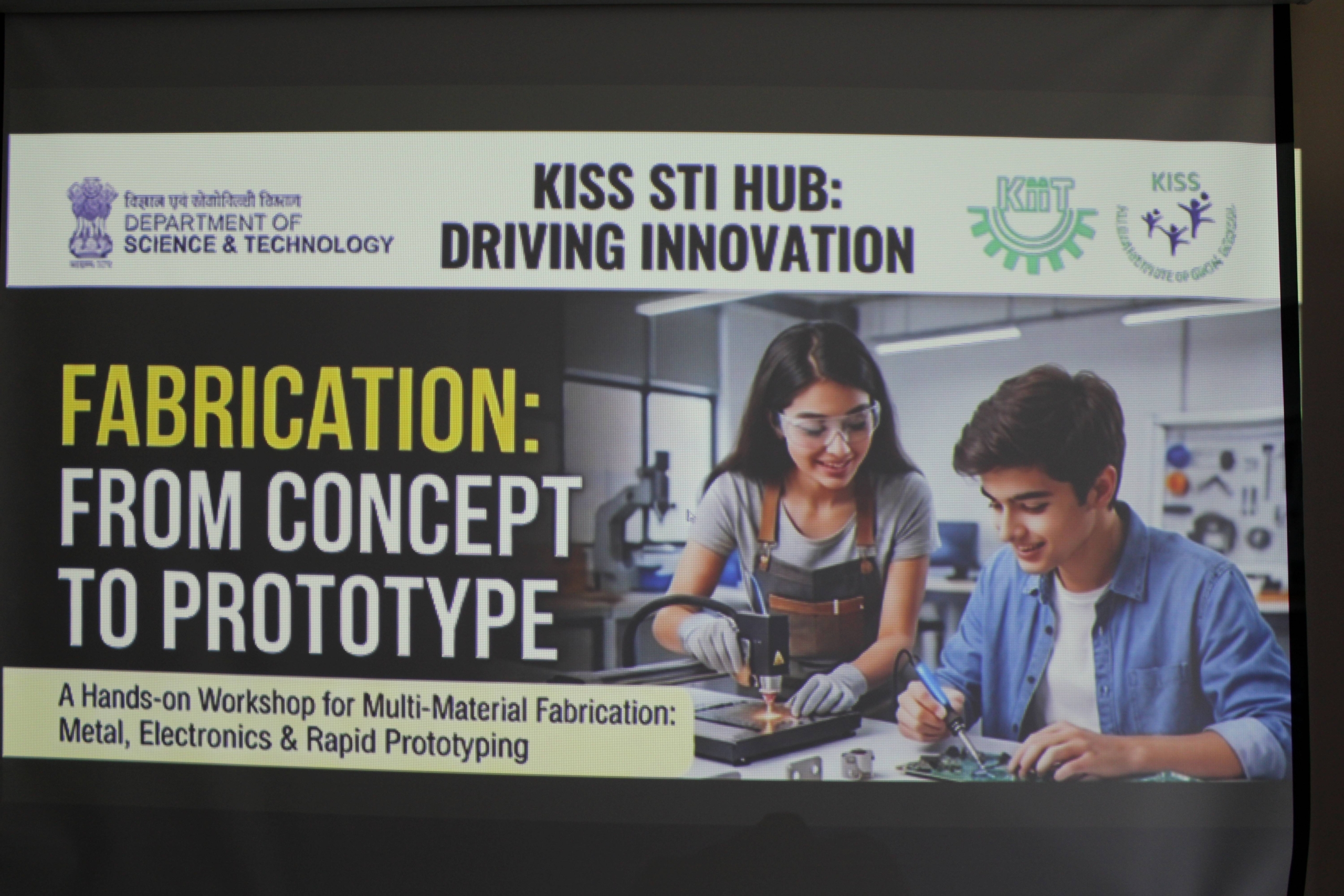
Date: 18th, 19th, and 21st September, 2026
Venue: KISS STI Hub for Tribals, KISS Deemed to be University, Bhubaneswar
Organizer: KISS Science and Technology Innovation (STI) Hub for Tribals
Key Partner: KIIT TBI
Lead Trainer: Mr. Surajit Paul, VP – Education, Karkhana Makerspace
- Summary
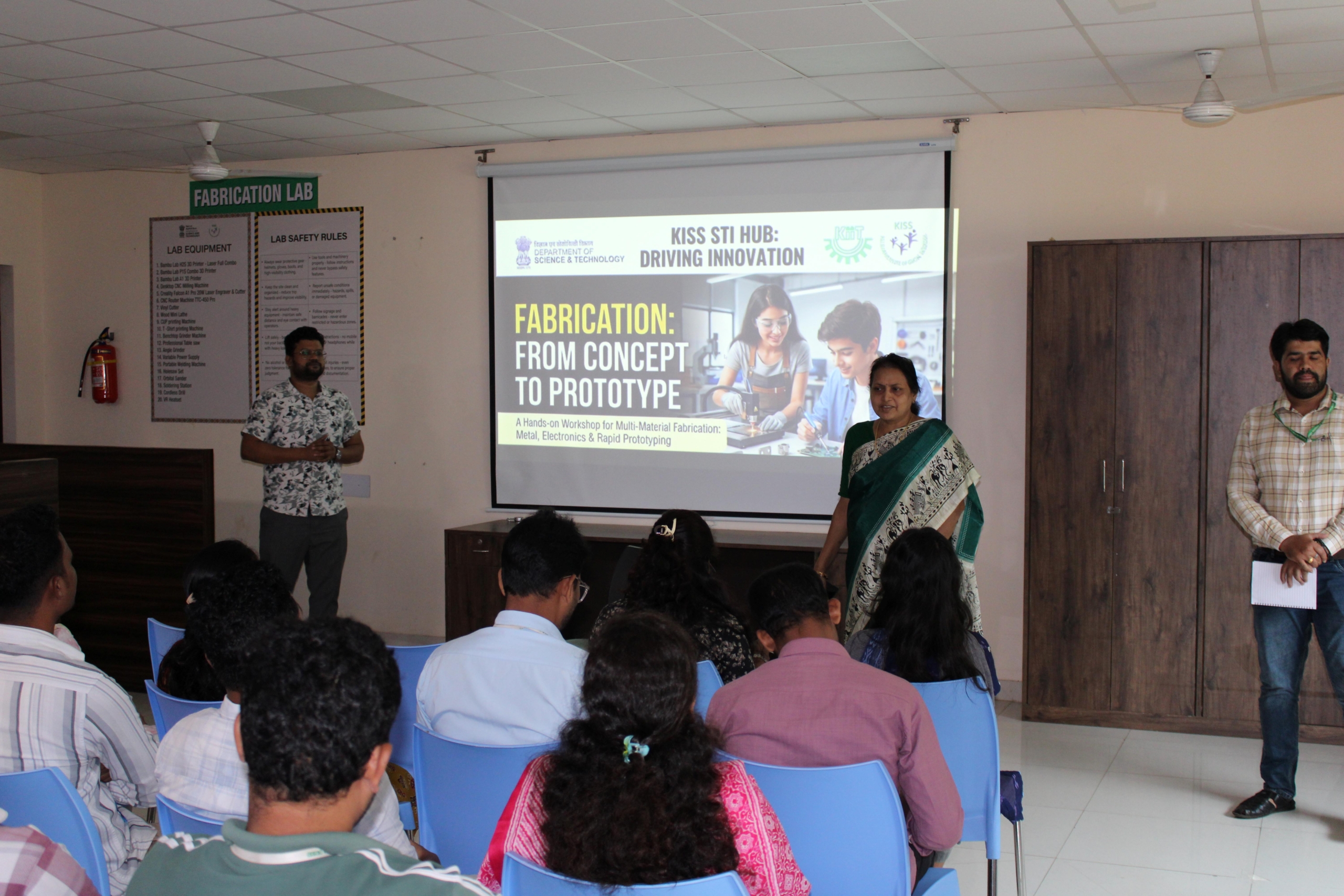
The Project – KISS Science and Technology Innovation (STI) Hub for Tribals successfully organized a three-day hands-on training programme titled “Fabrication: From Concept to Prototype” at the KISS STI Hub for Tribals, KISS Deemed to be University, Bhubaneswar. The programme was conducted in collaboration with key partner, Karkhana Makerspace, and was led by Mr. Surajit Paul, VP – Education.
The programme aimed to cultivate a maker mindset by providing practical skills in tools, mechanics, electronics, microcontrollers, and design thinking. The training focused on transitioning participants from technology consumers to creators and innovators through comprehensive hands-on experience spanning the full spectrum, from basic tool handling to prototyping functional solutions.
The initiative aimed to empower participants from different districts, STI Hub team members, and student innovation leads with the essential skills and mindset required to nurture a culture of innovation and self-reliance. Over three days, participants progressed from basic tool handling and structural mechanics to building functional circuits, programming microcontrollers, and finally applying the Design Thinking process to develop prototypes addressing real-world community challenges. The program culminated in a showcase of capstone projects, demonstrating the participants’ newly acquired skills and their potential to drive innovation at the grassroots level.
A total of 22 beneficiaries actively participated in the training sessions, gaining both theoretical knowledge and practical exposure to fabrication and prototyping.
- Progress Report (Session-wise Activities)
Day 1: The Maker Mindset & Fundamentals of Tinkering
Inaugural Session & Ice-Breaking (10:30 AM – 11:00 AM)
The programme commenced with a welcome address by Dr. Rashmi Mohapatra, PI of KISS STI Hub, followed by an introduction of the Lead Trainer, Mr. Surajit Paul. The session began with an engaging team-building activity that emphasized collaboration and creative problem-solving. Mr. Paul then delivered an inspiring talk on the Karkhana philosophy, encouraging participants to shift their mindset from being passive consumers to active creators. The concept of “Growth Mindset” vs. “Fixed Mindset” was introduced to set the tone for the three-day program.
Session I – Tools & Safety (11:00 AM – 12:00 PM)
This session provided a comprehensive demonstration of the STI Hub Toolkit, including cutters, screwdrivers, glue guns, and multimeters. Participants engaged in hands-on activities to learn safety protocols and correct handling techniques for each tool, ensuring they could work safely and effectively. The session emphasized the importance of tool proficiency as the foundation for all maker activities.
Session II – Mechanics & Structures (12:15 PM – 01:00 PM)
This practical session focused on understanding structural integrity using low-cost, everyday materials. Participants engaged in activities that demonstrated triangulation, load-bearing principles, and material properties. The session successfully demonstrated how creativity and basic engineering can solve practical problems, building confidence in participants’ ability to create functional structures.
Session III – Introduction to Electronics (02:30 PM – 03:30 PM)
This session introduced the fundamental concepts of voltage, current, and resistance using a relatable water analogy. Participants then engaged in a hands-on activity, successfully building a simple working circuit by lighting an LED with resistors and breadboards. This session laid the groundwork for the more advanced electronics work on Day 2.
Reflection & Wrap-up (03:30 PM – 04:30 PM)
The day concluded with a group discussion on “What surprised you today?”, allowing participants to consolidate their learning and share their experiences. This reflective practice helped reinforce key concepts and prepared participants for the next day’s sessions.
Day 2: Electronics, Sensors & Coding Logic
Session IV – Microcontrollers (11:00 AM – 12:00 PM)
Participants were introduced to the concept of a microcontroller as the “brain of a machine.” Through hands-on activities, they set up Micro:bit boards and successfully programmed their first task—blinking an LED, the “Hello World” of hardware. This session marked a significant milestone, as participants interfaced a computer with a microcontroller for the first time.
Session V – Sensors & Inputs (12:00 PM – 01:00 PM)
This session covered the theory of analog vs. digital signals. Participants worked hands-on with various sensors, including light sensor, ultrasonic sensor, and temperature sensor, to trigger outputs like LEDs and buzzers. The session enabled participants to build systems that react to their environment, demonstrating the power of sensor-based automation.
Session VI – Coding Logic & Automation (02:45 PM – 03:45 PM)
Participants learned to apply conditional logic (“If This Then That”) to create automated systems. They wrote code to build models such as a “Smart Dustbin” and an “Automatic Street Light,” demonstrating the power of coding to solve real-world problems. This session bridged the gap between theoretical coding concepts and practical applications.
Session VII – Rapid Prototyping Challenge (03:45 PM – 04:45 PM)
Teams were presented with “The Smart Village” challenge, requiring them to build a prototype using all the skills acquired over the two days. Projects included a water level indicator, a security alarm, and a solar tracker. This challenge tested participants’ ability to integrate mechanics, electronics, and coding into a single functional prototype.
Day 3: Design Thinking & Capstone Project
Session VIII – Empathize & Define (11:00 AM – 12:00 PM)
Participants were introduced to the Design Thinking process, with an overview of its 5 Stages: Empathize, Define, Ideate, Prototype, and Test. They identified pain points in the local community and rural setting. Through workshops, they created “User Personas” and “Problem Statements,” defining a clear problem to solve. This human-centric approach to innovation was a key learning outcome of the day.
Session IX – Ideate & Prototype (12:00 PM – 01:00 PM)
Using the “Crazy 8s” sketching method for brainstorming, teams ideated solutions. They then built their solutions using the STI Hub resources, including cardboard, 3D printed parts, and electronics, creating tangible prototypes. This session emphasized the importance of rapid iteration and creative problem-solving.
Final Presentations & Showcase (02:30 PM – 03:45 PM)
Each team presented their final prototype and explained the problem it solved. Mr. Surajit Paul provided expert critique and encouragement, recognizing the creativity and effort of all participants. The showcase demonstrated the practical skills and innovative thinking acquired over the three days, with projects addressing real community challenges.
Valedictory and Way Forward (03:45 PM – 04:30 PM)
The programme concluded with a valedictory session where certificates were distributed to participants. Mr. Paul delivered a closing talk on “How to sustain the maker culture at KISS STI Hub,” followed by a Q&A session. The event ended with a formal vote of thanks and a roadmap for future activities.
- Hands-on Practical Components
Participants gained hands-on experience in the following practical components during the training:
- Safe handling and use of basic hand tools and power tools
- Structural design and construction using low-cost materials
- Building basic circuits with LEDs, resistors, and breadboards
- Setting up and programming Micro: bit microcontrollers
- Interfacing sensors (light, ultrasonic, temperature) with microcontrollers
- Writing conditional logic code for automation
- Applying Design Thinking process for problem identification
- Creating user personas and problem statements
- Rapid prototyping using cardboard, 3D printed parts, and electronics
- Peer testing and iterative design refinement
- Outcome
- Total Beneficiaries: 22
- Participation From: Different districts, STI Hub team, and Student Innovation Leads
- Major Focus Areas: Tool handling, mechanics and structures, electronics, microcontrollers, sensors, coding logic, design thinking, and prototype development
- Impact: Enhanced practical skills in fabrication and prototyping among participants; increased awareness of the maker culture and its potential for innovation; strengthened capacity to identify community problems and develop human-centric solutions; creation of a core group of trained individuals capable of mentoring others and sustaining the maker culture at KISS STI Hub
- Acknowledgment
The programme was conducted under the guidance of the Project – KISS & KIIT STI Hub team:
- Dr. Rashmi Mohapatra, Project PI
- Dr. Snigdharani Panda, Project Co-PI
- Dr. Umesh Chandra Dash, Project Coordinator
- Jay Prasad Jena, Project Associate
- Soumya Ranjan Mohanty, Project Associate
- Tatteadharshee Mohapatra, Lab Assistant
Special thanks to Mr. Surajit Paul, VP – Education, Karkhana Makerspace, for serving as the Lead Trainer and delivering comprehensive hands-on training sessions on fabrication and prototyping. The success of the program was also made possible through Fabrication lab facility at KISS STI Hub for Tribals and all participants for their enthusiastic engagement, curiosity, and hard work throughout the program.