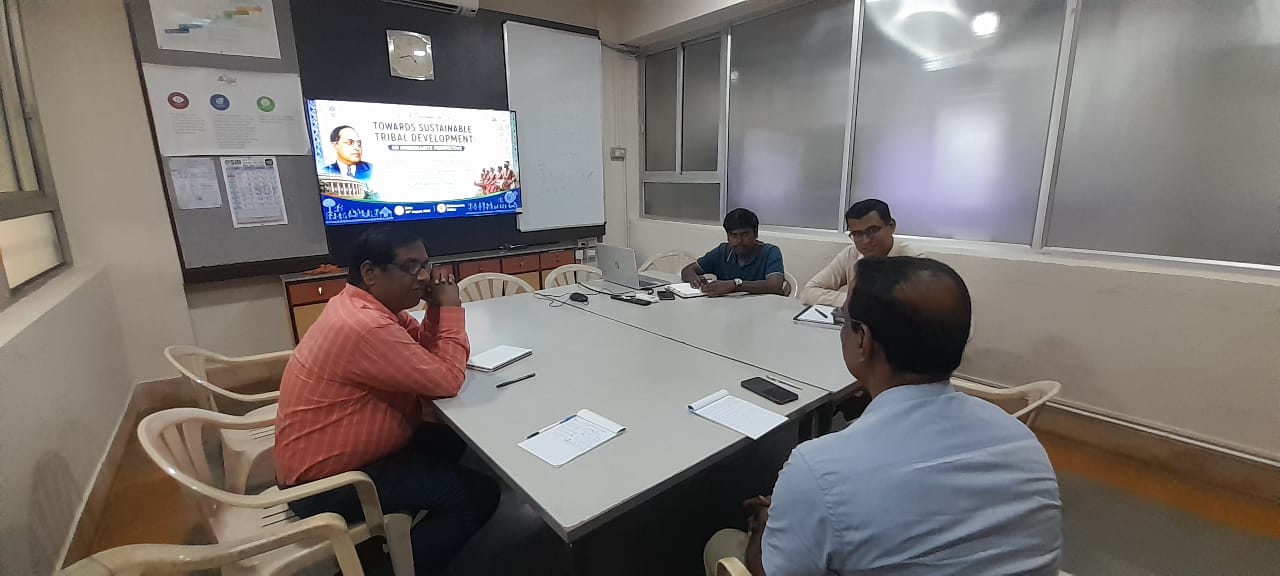
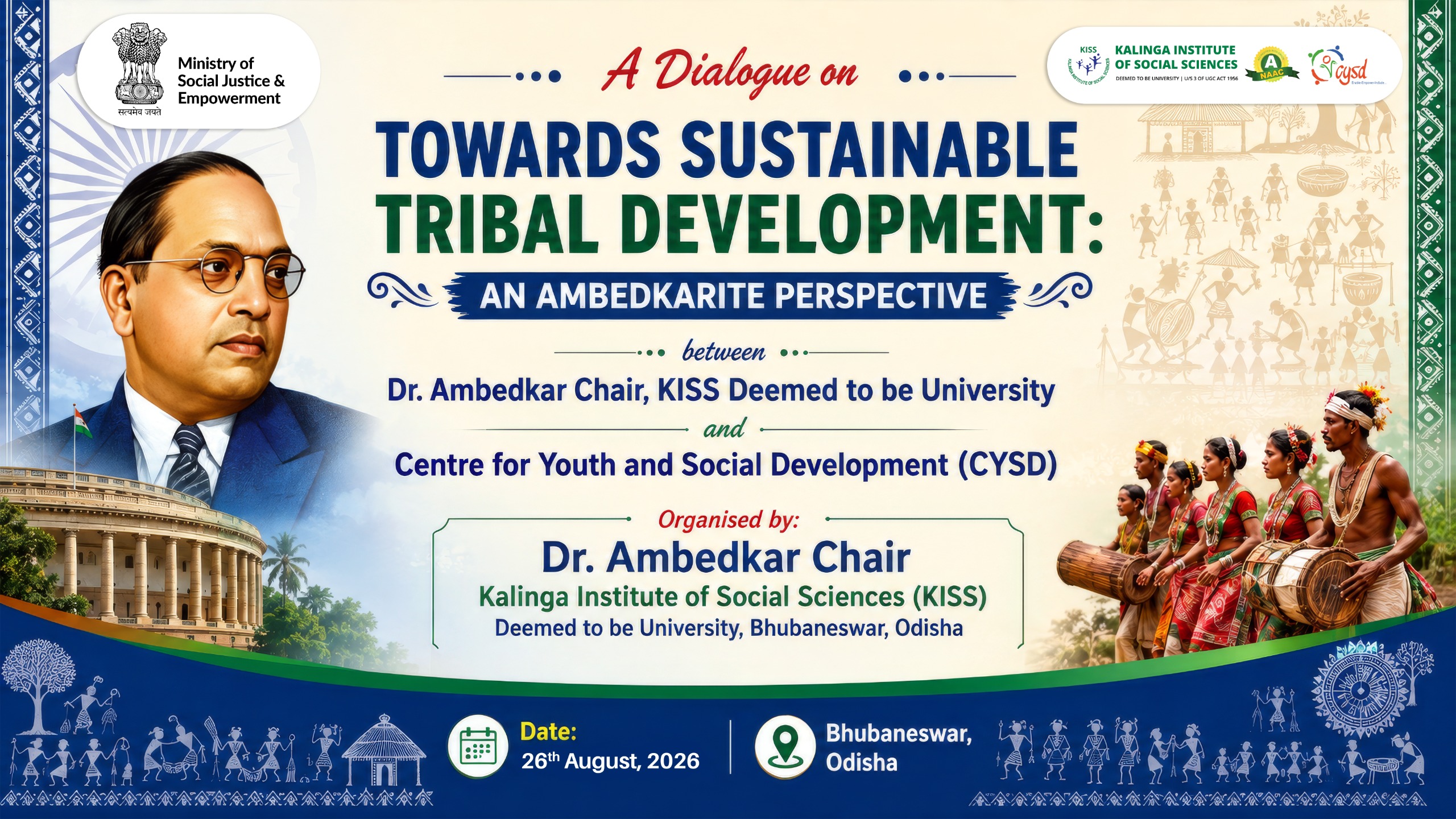
The Dr. Ambedkar Chair, KISS Deemed to be University (KISS-DU), and the Centre for Youth and Social Development (CYSD), Bhubaneswar, jointly organised a dialogue on the theme “Towards Tribal Development: An Ambedkarite Perspective” at the CYSD campus in Bhubaneswar. The dialogue brought together academicians, researchers and development practitioners to exchange ideas on sustainable tribal development, community empowerment and the relevance of Dr. B. R. Ambedkar’s vision in addressing contemporary tribal issues.
The programme commeced with a welcome address by Basanta Kumar Nayak, Programme Director, CYSD, who highlighted CYSD’s long-standing engagement with tribal communities across Odisha. He noted that for more than four decades, the organisation has worked towards sustainable, inclusive and community-centred development, focusing on the empowerment of tribal communities through long-term interventions and capacity-building initiatives.
Introducing the objectives of the dialogue, Prof. Chittaranjan Bhoi, Chair Professor, Dr. Ambedkar Chair, KISS-DU, outlined the mandate of the Dr. Ambedkar Chair sponsored by the Dr. Ambedkar Foundation, Ministry of Social Justice and Empowerment, Government of India. He explained that the interaction was organised to promote knowledge exchange and explore collaborative opportunities in research, documentation and field-based studies related to tribal development.
Prof. Bhoi emphasised that an Ambedkarite perspective on tribal development places social justice, equality, dignity, inclusion, participation and access to rights at the centre of development discourse. He stressed the importance of documenting grassroots experiences and community-led initiatives to better understand the effectiveness of tribal development interventions and public policies.
During the deliberations, Basanta Kumar Nayak presented CYSD’s major areas of intervention, including Tribal Sustainable Livelihoods, Tribal Local Governance and Tribal Inclusion. He discussed the organisation’s efforts to strengthen community leadership, promote local entrepreneurship and encourage sustainable livelihoods through indigenous agricultural practices and locally available organic farming systems.
Speaking on community outreach initiatives, Asish Kumar of CYSD highlighted efforts to facilitate access to government welfare schemes, including Direct Benefit Transfer (DBT), housing support and social security programmes. He also discussed the unique challenges faced by tribal communities living in remote and hilly regions and emphasised the need for development programmes to be responsive to local realities and community needs.
The dialogue further explored issues related to rights, entitlements and institutional monitoring mechanisms. Prafulla Kumar Rout, Research Coordinator, CYSD, shared insights on community welfare initiatives, monitoring systems and measures adopted to ensure effective implementation of development programmes. He referred to the Public Distribution System (PDS), the Forest Rights Act (FRA), Integrated Tribal Development Agency (ITDA) initiatives and various other government schemes designed to support tribal communities.
Participants also discussed tribal local governance and the importance of community participation in democratic and decentralised decision-making processes. The dialogue highlighted how meaningful participation in Panchayat and village-level institutions contributes to inclusive governance and accountable development. The participants noted that development must be assessed not only through economic indicators but also through the principles of social justice, equality, dignity, representation and access to opportunities.
A major focus of the interaction was the exploration of collaborative opportunities between the Dr. Ambedkar Chair and CYSD. Discussions centred on developing joint research studies, documenting successful community-led initiatives, analysing grassroots development models and producing evidence-based reports on tribal development. The participants agreed that CYSD’s extensive field experience and institutional resources offer valuable opportunities for academic research and documentation.
Key areas identified for future collaboration include documentation of tribal development initiatives, sustainable livelihoods, local governance, community participation, access to entitlements, local leadership, entrepreneurship and research on tribal development through an Ambedkarite framework grounded in social justice, equality, rights and empowerment.
In his concluding remarks, Prof. Chittaranjan Bhoi described the dialogue as the beginning of a meaningful institutional partnership between the Dr. Ambedkar Chair, KISS-DU and CYSD. He emphasised that continued engagement, field-based learning and collaborative research would contribute significantly to strengthening knowledge, policy understanding and evidence-based approaches to tribal development. The participants agreed to continue the dialogue through future meetings and consultations on specific areas of research and collaboration.
The dialogue reaffirmed the shared commitment of both institutions towards promoting sustainable tribal development rooted in the values of social justice, equality, dignity, inclusion, participation and empowerment. It also underscored the importance of collaboration between academic institutions and grassroots organisations in generating impactful research and policy insights for tribal welfare and development.